Episode 248 - Anna Grodzki, Matoke Tours Africa
In this episode of Soul of Travel, Season 6: Women's Wisdom + Mindful Travel, presented by @journeywoman_original, Christine hosts a soulful conversation with Anna Grodzki.
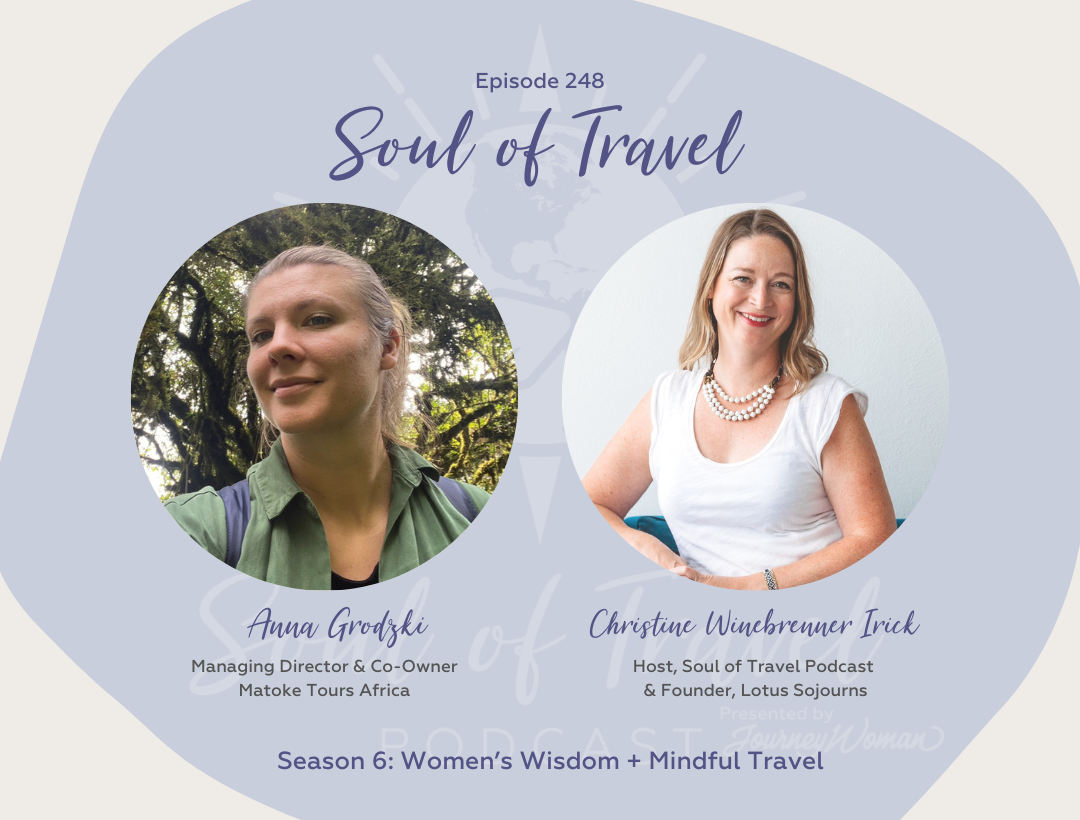
Anna Grodzki is Managing Director and Co-Owner of Matoke Tours Africa, a leading DMC based in Uganda. Committed to exploring regenerative thinking, place-based sustainability, and innovative impact reporting, Anna sees tourism as a catalyst for connection and creating space for personal and collective transformation. Every journey she and her team designs aims to enrich travelers’ lives while supporting the wellbeing of the communities and ecosystems that make these experiences possible.
A lawyer by profession, Anna began her career working at the intersection of culture and policy, including an internship with UNESCO in Uganda. She joined Matoke Tours in 2012, first as Business Development Manager for the German market, later becoming Director and Co-Owner. She also serves on the board of the Netherlands Uganda Trade and Investment Platform and contributes to development cooperation programs as a consultant, bringing a private-sector voice and practical experience into policy and program design.
At Matoke Tours, she loves building projects that give depth and purpose to travel — from Travelling Sisterhood Safaris, empowering women through adventure and connection, to Matoke Academy, a digital B2B learning platform, and Trails of Tomorrow, a soon-to-launch accelerator for new tourism products in Uganda.
Anna Grodzki didn’t set out to become a tourism leader in Uganda, but when she followed the meaning and inspiration she found in the world of travel, it became inevitable, leading to years of transformation, meaning, and a positive impact for communities beyond what she may have imagined.
“I am German and Polish. I grew up in Germany, and I came to Uganda in 2011. So this is when I had just finished university. I had just passed my bar exam. So I’m a lawyer by profession. I was supposed to be a lawyer by profession, I should say maybe. And my journey to Uganda was... something that I hadn’t planned for.”
As Christine shares, Anna is one of many Soul of Travel guests who launched a career – only to find that travel would become their true calling.
In that moment, Anna chose to be open; she applied for an international professional internship: “And it came back with a positive answer for Uganda and UNESCO as a placement… I was really not expecting it.” Yet, she leaned in, open-hearted. Her first year in Uganda, interning for the UNESCO National Commission, placed Anna into unexpected proximity with tourism, conservation, and community.
“There was one on biodiversity management and there was one, very important one for me, which was Human Wildlife Conflict… So this was kind of my entry point into this world of tourism, but also conservation and culture… from a program perspective and very much from an impact perspective as well.”
When Matoke Tours, a regional company, reached out after she’d helped them with a legal translation, Anna accepted their offer to develop business on the German market; the rest is history. “And now, 14 years later, here I am still with Matoke Tours. I became director along the way and co-owner along the way as well. And it has been a wonderful, wonderful journey.”
Women-Focused Travel and Leading Responsibly
For Anna and her colleagues, identifying the gaps was only the beginning—the real challenge was dismantling the fact that in Uganda’s tourism industry, women’s roles were almost entirely absent in some areas.
Among the greatest gaps: access to leadership training, societal expectations that raise girls to accommodate others above themselves, and the missed opportunities for girls to step into leadership roles both at home and in the workplace.
Anna and her team recognized that in order to improve the opportunities for women to grow into more forward-facing roles in tourism, those opportunities needed to be created with intention, resourcefulness, and commitment.
“Many other women who are doing amazing work – all the women who work in communities, all the women who are mentoring young girls who would want to work in tourism… None of us could do this, do this without the other, and I could certainly not promote anything or develop any product without all this work that is done on ground.”
Anna describes how the Matoke Tours team partnered with other Ugandan companies to co-fund and co-organize development projects, including Adventure Tourism Uganda, which implemented mentorship programs, internships, and classroom-based courses. The results of these collaborations have continued to grow to this day.
Traveling Sisterhood Safaris
Their work in tourism equity launched into a greater conversation, leading Matoke Tours into launching the Traveling Sisterhood Safaris, growing from the idea of a ‘boozy brunch’ into a full-scale safari aimed toward creating safe, welcoming spaces and creating opportunities for women in tourism and travelers.
What emerged was both simple and, somehow, radical—an itinerary that celebrated women’s perspectives and preferences, brought together female guides and service providers, and created space for mutual connection and learning.
“We call it a Traveling Sisterhood Safari because it was really meant to be, you know, we created it for ourselves, but also with the thought of, okay, if other women would join us, we would want to connect and understand how they experience Uganda, what other things they love doing. So that connection element between us developing it and then thinking of participants was really like the most important part for us, which I think was really felt by the participants as well.”
Curiosity and Humility in Travel Leadership
Anna’s humility about her own role—especially as a foreigner and person with privilege in Uganda—is so clear in this soulful conversation.
“I just found sense in doing it in a way that I… work for a company that is big. With that volume comes some kind of power… how you channel those income streams. I also have the connection to sense. So for certain things that we do, I just realized it's so much easier for me to reach certain audiences… So, for me, it’s important that I use it, because in the end I channel this to… as an opportunity to other people.”
Recognizing that innovation happens in collaboration, not a vacuum, is key. It takes a clear and intentional drive to work alongside people who may have information, experiences, and perspectives different from our own. This is paramount in Anna and her team’s work in Trails of Tomorrow, which supports sustainable growth in Uganda’s tourism sector.
For Anna, change is never a finished product; it’s a process. That’s true for business growth, industry practice, and even resources designed to help travelers behave responsibly. Anna’s team created a “Guide to Responsible Travel in East Africa” as a growing conversation, a living document to support travelers in making decisions to minimize negative impacts and focus on creating more good.
In reflecting on what the “soul of travel” means to her, Anna simply says: “For me it’s connection… We are already all so interconnected, but it’s important to really feel it and experience it in real life. So, and also connection to place, I find it so important, like to experience yourself in a new context, and then seeing how you connect to a certain place.”
Being open to serendipity, saying “Yes!” to the unexpected, and insisting on meaningful change and continuous curiosity show that mindful travel is never about geography; it’s about forging new pathways together.
“We are already interconnected, but it’s important to really feel it and experience it in real life… to experience yourself in a new context, and then seeing how you connect to a certain place.”
Soul of Travel Episode 248 At a Glance
In This Episode, Christine and Anna discuss:
How decisions open doors and a single “Yes!” can keep on giving for years to come
The process of creating Traveling Sisterhood Safaris
Identifying and closing industry gaps for women in tourism
Curiosity, adaptability, and flexibility leading to innovation and reward in entrepreneurship
Love these soulful conversations and want to expand our reach? Support Soul of Travel on Buy Me a Coffee, subscribe here to Apple Podcasts, and rate and review your favorite episodes.
To discuss advertising or sponsoring an episode, reach out to Christine at souloftravelpodcast@gmail.com.
Resources & Links Mentioned in the Episode
Visit Matoke Tours to explore your next visit to Uganda.
Connect with Anna on your favorite social media network! Instagram / LinkedIn
Learn more about Traveling Sisterhood Safaris.
Subscribe for news about Matoke’s soon-to-launch eco-conscious and community-led tourism accelerator, Trails of Tomorrow.
Related UN Sustainable Development Goals
Sustainable Development Goal #5: Achieve gender equality and empower all women and girls.
Sustainable Development Goal #8: Promote sustained, inclusive and sustainable economic growth, full and productive employment and decent work for all.
Sustainable Development Goal #10: Reduce inequality within and among countries.
Sustainable Development Goal #12: Ensure sustainable consumption and production patterns.
Sustainable Development Goal #17: Strengthen the means of implementation and revitalize the Global Partnership for Sustainable Development.
About the Soul Of Travel Podcast
Soul of Travel honors the passion and dedication of people making a positive impact in the tourism industry. In each episode, you’ll hear the stories of women who are industry professionals, seasoned travelers, and community leaders. Our expert guests represent social impact organizations, adventure-based community organizations, travel photography and videography, and entrepreneurs who know that travel is an opportunity for personal awareness and a vehicle for global change.
Join us to become a more educated and intentional traveler as you learn about new destinations, sustainable and regenerative travel, and community-based tourism. Industry professionals and those curious about a career in travel will also find value and purpose in our conversations.
We are thought leaders, action-takers, and heart-centered change-makers who inspire and create community. Join host Christine Winebrenner Irick for these soulful conversations with our global community of travelers exploring the heart, the mind, and the globe.
Subscribe & Review on Apple Podcasts
Are you a Soul of Travel subscriber? Click here to subscribe to Apple Podcasts, so you don’t miss the latest episodes!
Listener reviews help expand our reach and help us rise up the ranks! Rate and review your favorite episodes on Apple Podcasts or your preferred podcast app.
Credits. Christine Winebrenner Irick (Host, creator, editor). Ceylan Rowe (Guest). Original music by Clark Adams. Editing, production, and content writing by Carly Oduardo.
Learn more about Lotus Sojourns
Looking for ways to be a part of the community? Learn more here!
Find Lotus Sojourns on Facebook, or join the Lotus Sojourns Collective, our FB community for like-hearted women.
Follow us on Instagram: @journeywoman_original, @she.sojourns, and @souloftravelpodcast.
Become a supporter of Soul of Travel!
WE WON A BESSIE AWARD! The Bessie Awards recognize the achievements of women and gender-diverse people making an impact in the travel industry. To view the complete list of 2022’s winners, visit bessieawards.org.
Monthly Soul Circles!
Rekindling the spark of connection that began with daily “3:33” virtual gatherings, Christine is also launching monthly Soul Circles, to be held on the third Thursday of every month. These gatherings promise meditations, guest-led workshops, and open-hearted conversations, open to all who seek community! Learn more by joining the Lotus Sojourns Collective Facebook group.
Soul of Travel Episode 248 Transcript
Key Words: women’s travel, transformational travel, sustainable travel, social entrepreneurship
Christine: Welcome to Soul of Travel. I am your host, Christine, and I am very excited today to be recording the last in our series focusing on women leaders in Africa. And today I am speaking with Anna Grodzki, who is the managing director and co-owner of. Matoke Tours Africa. Um, and it's really fun to be having this conversation with you right now 'cause I've just been like silently watching as my friend Iris CCU has been in Uganda and having some experiences.
So this feels like, um, a very timely conversation. 'cause I, it feels super relevant in my mind in this. Moment. So that just adds an extra layer to the connection in this conversation. Um, but firstly, let's just welcome to the podcast. Thank you for being here.
Anna: Thank you so much. I'm very, very excited about this conversation and, um, so amazing to hear that you followed Iris's, uh, journey.
We've just been on a trip together, so that's amazing.
Christine: Yeah, I was so excited when I heard she was going and I didn't even realize she was traveling with you. And then I saw that start popping up when I was like, oh, it's such a small. Giant world. So
Anna: yes, I love it. It just feels so nice to have so many connections and like it's, it just adds up like this wonderful network, so it's really great.
Christine: Yeah, and I think especially when you're thinking about all of the opportunities that you have of who to work with, when you go to all these different places, to be able to find people that you feel like you have that connection with, it just kind of helps to find. The needle in the haystack, if you will, to, you know, find the kind of people that are aligned with you and view travel the way you do.
And then to see someone else has already gravitated toward that, it feels a little bit validating. So I love that. Um, Anna, before we kick off, I'd love to just let you introduce yourself to our listeners and tell them a little bit more about who you are and, um, motoki tours.
Anna: Thank you so much, Christine.
Um, yeah, so my name is Anna Gretzky. I am German and Polish. I grew up in Germany, um, and I came to Uganda in 2011. So this is when I had just finished university. I had just passed my bar exam. So I'm a lawyer by profession. I was supposed to be a lawyer by profession, I should say maybe. Um, and my journey to Uganda was.
Yeah, it was something that I hadn't planned for. I just felt, um, after studying that I, something like didn't quite resonate with me and I did not have a vision of where I would see myself professionally. So I really wanted to get out and get into a new context and kind of give myself a little bit of time to, um, to think this through.
And I applied for this program called, which was funded by the German government. It basically like would match you with a cultural institution for professional internship. So I left my application completely open, like whoever I want to match me with, you know, I'm open. And it came back with a positive answer for Uganda and uh, UNESCO as a, as a placement.
And I was, yeah, really not expecting it. So I thought, well, let me just Google Uganda again to remind myself a little bit more. Uh, about a few facts and I was really thinking like, no, I'm definitely still open for it. Like I said, I'm open to anything, so I am open to this. Um, so I spent my first year in Uganda interning with the UNESCO National Commission here, and it, um.
Just so happened that at this time they had put me in programs which were tourism related. So there was one on biodiversity management and there was one, uh, very important one for me, uh, which was Human Wildlife Conflict. So it was about local communities and the national parks who were, um, displaced when the national parks were Gazette it and how that influenced, uh, many of their traditions and habits.
Um. So this was kind of my entry point into this world of tourism, uh, but also conservation and culture and kind of from a program perspective and very much from an impact perspective as well. So I learned so, so much if it was such a privilege to, to get so much access to information and to communities and just so much knowledge, uh, in my first year.
And I was really fascinated by it. Um. And then again, another unexpected thing happened and um, Matos reached out to me through a mutual friend while I was still here on my internship, and I needed someone for a legal translation, like, well, probably the most boring job you can imagine, like translating their terms and conditions into German.
So someone had linked me because of my legal background. I was like, yeah, sounds good. I would love to earn some extra money for this small assignment. And we kept in touch and they were looking for someone to do business development on the German market for them. And they offered me the job and I was like, well, never thought of working in tourism, but I had just closed, you know, this chapter of my life, back home wrapped up everything I, you know, moved out of my apartment.
I thought, well, why not? You know, sounds really interesting. I would love to experience this. And now, 14 years later, here I am still with my Toku tour. I became director along the way and co-owner along the way as well. Um, and it has been a wonderful, wonderful journey. And I'm just like. I dunno what exactly happened to me in this moment that I just decided to follow.
Like this curiosity and the feeling of, yeah, why not? Uh, instead of like weighing back and forth 100 options, what is the reasonable thing to do? Um, but I'm so glad that it happened like this. So this has been kind of my journey into tourism and into working with Metca Tours.
Christine: Thank you so much for sharing that.
I, it would be really fun for me to go back and find out how many lawyer turned tourism professionals I've had on the podcast because actually I think it's quite a few. So yeah, I don't know what that says about the transition between the two industries, but, um, yeah, that's very interesting. And I love, like you were saying, that one, you kind of didn't put any.
Guard in place for what you were, were willing to accept. You just knew that the one thing didn't really feel right and so you're like, basically anything else is a possibility. And for me, I always love to see then how the universe answers that when you just kind of give that much space and to see, yeah, again, like.
How many people have landed places they would've never picked, right? Like they might really be Googling like, I don't know where this place is. Tell me about it. And then they end up there. And um, I just think that's a really magical kind of bravery, I guess, to just be that open to possibility and then to see kind of.
How synchronously you're rewarded for saying yes and that like the next thing and the next thing. And like you said, 14 years later you're still there and you're still kind of receiving the benefits of this. Yes. All this time ago.
Anna: Yeah, absolutely. Oh, that's such a beautiful way of phrasing it, but I absolutely agree.
Um, yeah, I just feel like very lucky that things fell into place like this, and it's also good to remind yourself of that from time to time, I think, because, you know, in the everyday life it's not so easy to be brave about big life decisions or maybe always stick to so, so good. Maybe to remind yourself like, oh, I'm in this place because yeah, I put my guide down and said yes.
Christine: Mm-hmm. And I think, yeah, it is really helpful. Like you said, you, you get distance from that moment and then you get caught up in living your life and sometimes, you know, it's easy to lose track of this first spark or catalyst. And even in our businesses, I know when I'm talking with people, sometimes I'll hear them say something and reflect it back to them and then they're like, oh yeah, I kind of forgot about that initial.
Passion or curiosity or path, and it kind of reignites and reconnects them to that moment. So I think that's also the power of this kind of storytelling is it really can help us see our own story and remember that we're a part of it and we're not just kind of going through the motions.
Anna: Yeah. Oh, I need to, I need to write that down for myself.
I think, uh, because indeed it's good to have this reminder. I do try, when I think of it, I do try to create like those pockets for myself, pockets of time or, um, or just like capacity, mind, space, you know, where I really feel like, oh, I need to do something that gives me that feeling. So, for example, the trip you just mentioned, I rarely, really, rarely go.
Um, on trips in Uganda with potential new partners or, uh, with clients. You know, usually my work travels like always abroad to trade shows and networking. So also taking the time to do this now was, yeah, I really felt, wow, it's such a again privilege. Like to go with five people. I've never been to Uganda and like, just give myself the time to experience it with them again.
Right? And to see all the things that they notice and it's just such a reconnection to kind of base all. Like just creating space for things that I'm really passionate about, like within my work. Um, that you don't just do the day to day and, you know, emails and finances and reports and so on, but that you kind of really create those pockets or like, yeah, I, I try to call it like, I'm following my curiosity, like if I feel, oh, I'm curious about this, I'm going to try and give it time, because I realize this is like where the best ideas happen as well.
Christine: Yeah. Yeah. And again, that's also something that comes up often is people talk about how they got into travel because they love travel. And then you find out when you're in the tourism industry, your travel becomes business or your travel becomes, should shoulds and to-dos. And it's not actually like the travel that maybe ignites passion.
And so we, there's this. Tension, I guess, that people don't really resid recognize if they're not in the industry, that you, you become such a part of travel, but then you are also really distanced from the travel itself. And as you were talking about kind of reconnecting with Uganda and being out and traveling, I, I'm wondering if that reminded you of when you first.
Arrived and what that was like for you coming from, you know, Germany and arriving in Uganda. I know the first time I went, um, I've only been once, but I just, oh my gosh. I just loved it so much and I couldn't really explain why, but there was just a way that like the land felt and the way the, the people felt to me and like.
I can really, in my body remember walking on a few certain trails and it almost moves me to tears because there was a part of me that felt so home and so deeply connected and so in awe, like I was really, it was such a powerful experience for me being there. So whenever I think about kind of seeing that place for the first time, first time, or translating that to other people.
Experiencing new places for the first time, like trying to tap back into that awe, I think is really important. But for you, what was that like? How did, how did your body kind of land in Uganda?
Anna: Oh, I, I love hearing your story though, like, it's so wonderful. It's so nice to hear that, that this was your Uganda experience, but it also totally resonates with me.
Like I, I completely understand what you're talking about. I don't know, I think there's just something like, there's. An abundance, I feel is maybe like the closest word I can find for it in so many things. Like nature is just so abundant and then there's like this way of life that feels very abundant.
You know, like so many connections and yeah, such a genuine, and there's so many things. For me it's abundance, like, and, and this is the feeling I had when I, when I first arrived, I just felt like. Wow, this is a very different way of life in general. Just like being able to connect with so many people. I don't think that is a way of life that I experienced in, in, in Germany so much, you know?
Um. I think that just felt different, like community, like an instant sense of community as well. And for me it was in Kampala, so more in an urban setting for other people. They have more experience at like up country or if they stayed somewhere or traveled, um, in the country. So it seems to be something where is quite universal.
Um, for me, like a very connecting element right now on this trip was as well to my first trip, um, on the first trip. With Matoka tours when I started a job and it was basically for me to get to like a group tour of clients just to get that experience. People came to me that we, we met on the road and told me that like, you know, oh, I have a boat and now I do transfers and ma has given me so much business, like, my kids went to school because of this.
Or you know, a guy to said like, we really appreciate the business. Like this was really such a common thing that people, even to me who just joined, they would like really approach me and say like, oh, it's so great working with you. And I never thought about like tourism in that sense of like, wow, we actually, you know, we are really on eye level.
This is not in,
we collaborate and everyone benefits, like if we set it up in the right way. And that was like a, something that really shaped like how I work and like what I see as MA was DNA as well. And also now going on this trip. Same way. You know, like it's just so amazing to go and visit, let's say a community project, and then they'll tell you like, yeah, it makes such a difference that you send clients here.
And then I know on my side our travelers go there and they have an amazing experience. So it's like it's really a win-win. Ideally how it should be. So that is really like a big connecting element for me. And one where I really feel so proud of the work that we do as well. 'cause it's like we create so much joy for people, but also so much tangible benefits.
So it's really, yeah, it feels great to do something that feels meaningful to you. So,
Christine: yeah, I love that. And that's even kind of an extension of that energy, of abundance and I, I agree. I feel like. That is maybe what I also felt, which is interesting because a lot of times when Westerners think about traveling to Africa, abundance might not be the word or the idea or the energy they're thinking of.
And I actually had a meal with this man, um, when I was there, and that's exactly what he was trying to share with me. You know, he prepared this. Meal that covered the whole floor of this, um, hut outbuilding. And we sat on the floor and ate. And I mean, uh, it was such an abundance of food. And he, he, you know, he said, I wanted to prepare for this, for you to extend my gratitude to being here and also to show you all that we have because he said, I couldn't, I could never give you a dollar, but I can give you everything you need.
And that was just. That really shifts perspectives to have that kind of experience and to have someone say something like that to you to realize like where we put our value on things in our lives and how much we fret about the dollars we need to have in order to be nourished and in reality, you know, that.
That's this other thing that we've built up as humans. And, and, and the truth of it was that he can give you everything you needed in terms of community and food and nurturing and, you know, wellbeing. And I, I just was like, wow, this is so incredible. So that's definitely, you know, I, I carried that forward with me.
And the other thing, I loved how you were talking about. Kind of seeing tourism in action on the ground. That was the other thing that I noticed as well. 'cause it was one of my first trips, really engaging with kind of all the levels of the tourism supply chain and seeing who is impacted by travel and not just the people in offices, but like all of the touch points and, and to like witness.
The change that that creates and I just was really moved by that and it was something I have also carried with me when I think about what travel can do. I always kind of picture these moments and I'm like, oh, it was for her and it was for this boy, and it was for this village. Like that is what travel can do.
So I think we'll get into that more as we're talking, but I just think, um, I love that there's that synergy in our stories there. Um, one of the things that you and I talked about, uh, when we were preparing for this conversation. Is using our voice and how we can kind of use the position we have to amplify and create opportunities.
So I think that's kind of an extension of what we were just talking about. And then also kind of the dissonance of doing that as someone who's a foreigner, even though you've lived there now for so long, like how you navigate. Maybe any discomfort associated with that or how you kind of try to use that in the most positive way possible?
Anna: Yeah, it's such an important question. I'm, I'm really glad that you're asking this, um, because indeed there are definitely moments where I, yeah, we have to like pause and, and question a little bit. Like, okay, am I doing this the right way? Yes or no? Is this still okay? Um, but I think what it comes down to for me.
Um, it's really like what you said, you know, I, I needed to understand what is the best possible way for me to use my voice, my privilege, you know, everything that I come with. Um, and for me, I just found, um, sense in doing it in a way that I, well, I work for, to a company that is big. You know, we do have. Of clients coming in per year.
So with that volume comes, you know, like some kind of power, I want to say, right? Like how you channel those income streams. So I also have the connection to. Sense. So for certain things that we do, I just realized it's so much easier for me to reach certain audiences, either to promote a product or to maybe, you know, create awareness, let's say, well, we spoke about female tour guides in particular, right?
Like how to create more opportunities. I just feel that I have more of these opportunities. So, um, for me it's, yeah, it's important that I use it because in the end. I channel this to, you know, to as an opportunity to other people. So this is kind of how I decided, like to navigate it for myself. But of course, again, maybe using the female tour guide example and, and tours like centered around women and female service providers like they are.
So many other women who are doing amazing work. You know, all the women who work in communities, all the women who are mentoring, uh, young girls who would want to work in tourism. Um, anyone who hires a woman to work in tourism. So obviously none of us could do this, do this without the other, and I could certainly not promote anything or, you know, develop any product without all this work that is done on ground.
Christine: Yeah. Um, yeah, I, I love that way of kind of channeling what you have and the, the gifts that you have and the privilege you have to be able to create a bigger ripple and just kind of acknowledging it and working with it and let, instead of having it work against you. 'cause I think that sometimes. We'll find ourselves in those positions where either being a foreigner or being a woman can work as a disadvantage, but if you can kind of flip the script and use it to your advantage, I think, um, it's so powerful and I love being able to see that.
And you did mention, you know, some of the work you're doing. In toward, um, towards empowering women in the country and really ensuring that women are playing an important role in shaping what tourism looks like in Uganda, which is something I loved learning about you. Um, you mentioned the female tour guide training and mentoring, and you also have things like driving courses and female only tours.
I would love to talk a little bit more about like. Why is this so important to you personally and to Matoka tours? And then can you maybe share some of the shifts or impacts you've seen, as well as maybe any challenges you've had to overcome in bringing this into the culture of your company?
Anna: Yeah. Um, that's such a complex, big topic.
I love talking about it. 'cause this has really been a big part of our work for the last couple of years. Um, so maybe how it started, I think in the first place was really during, uh, the COVID time, the lockdowns, um, you know, it was a time we were actually really, really busy because we had so much to do with like reschedules and, you know, all the admin stuff around to us that were not happening.
So it was a lot of. Well, like many others, like dealing with a lot of negativity and uncertainty and, um, me and three of my colleagues, my female colleagues, we were kind of like doing this creative work a little bit, like creating those pockets, like I said, and we just thought like, oh, how would we, what kind of tr.
Do, like if we could travel right now in Uganda. Right. So it was kind of like really this little brainstorm, but it like, it was so nice because it just reminded us of all the things that we like to do and we were like, oh, I would love to add this. And oh, we should like start, you know, with a, with a boozy brunch on a boat and we should end with this.
And it was just like such a nice. Like genuinely nice conversation we had. And then we kind of picked it up from there and we thought like, oh, you know what? Like actually, you know, why wouldn't we make this a product? Like we should actually just pilot this. And we did. Um, and it was such an amazing experience to be, to actually run this tour.
We all thought like this was such a labor of love, almost like to make this happen and, you know, had this little hopeful moment to then launch this program that we did. Uh, we call it a traveling sisterhood safari. Because it was really meant to be, you know, we created it like for ourselves, but it was also like with the thought of, okay with other, uh, women would join us.
Like we would want to connect and like kind of understand, um, how they experience Uganda, you know, what other things they love doing. So like that connection element between us developing it and then thinking of participants was really like the most important part for us, which I think was really felt by the participants as well.
Then in the end, um, so this was. I would say like kind of this like starting point on um, women focused travel. Um, but then when we were getting into the details of it, like I really wanted, you know, female rangers who were like, oh, never actually particularly requested for that. Is that even possible to request?
So all the logistics around that really was so eyeopening. And then the most important aspect of it was actually to think like, oh, we should also have a female guide, a driver guide, um. And I, when I thought about it, I thought, I know one female driver guide and we are one of the biggest companies in Uganda.
I'm like, how did I never think about this? Like that? This is something that is just not okay in that sense. Um, so it was really, yeah, I just like couldn't believe that. That was the norm, like no one would questioning it, but also said I had never questioned it. Like that was kind of like the most, uh, surprising thing for, for, for me.
So we did like a little bit of research. We tried to reach out through our networks, like who is available, are there female drivers? But we just don't know about them. Um, and that led us to realizing, okay, we are actually a big company and an employer, like we should be actually creating those opportunities as well.
Um, so having set that intention was like very Yeah. Fundamental I feel in the way how we moved from there. So around five, six years ago, uh, we had the opportunity to, um, do like a call. Co-funded and co-organized project. So actually there were two, there was Adventure Tourism Uganda, where we got together with six other companies and we all developed, um, developed adventure in Uganda, either on the product side or on the guiding side.
So we had some female tour guide trainings. Under this program. So getting co-funding just enabled us to have bigger scale. And there was another one called, which is like an open source tourism curriculum. So under this, we did this female target training with, um, one month, uh, classroom-based course, but all delivered by industry experts and then a mentored internship.
So really realize, realize like that. Made a big, big difference. Literally just even creating those role, you know, like those role models and giving those young women the opportunity to try, um, if they want to be a tour guide. There was a little bit of a challenge there, um, especially in the co-funding space.
Um, you know, in development corporation, I often find like the more programs I see that the markers for, for impact or success would not necessarily match. For success as a company, you know, so often it's um. Let's say if it's 100% of people who pass their exam to become a tour guide, that's success. But I, for example, look at it in a way, what I want to do is create opportunity.
That means someone can try it and decide, that's not for me, because it's a tough job. But if you never try, like you'll never know. So this is like where we had a little bit of, um, where I was thinking like, I think we have to try to get more partners in the private sector as well to really make a big. Um, so this was one very important lesson I think for us going forward.
And another one was as well, you know, there's like the practical side of things, like actually doing a training or driving course, which are very tangible and you know, you can see the results. They also look nice if you use them in your marketing and your impact report, but there's also other work and I think.
This is maybe where my legal background comes in. But um, I also helped like do a gender assessment for the tourism sector. So we kind of really sat down and listened to so many women who work in tourism, like guides, activity providers, lodge owners, um, to operators. And we kind of came up with this list of what are the challenges they are facing.
Um, so there we went way more into maybe lack of leadership training. You know, girls are raised in a certain way, often, certainly here in society. You know, expectation is always to be, um, yeah, to be accommodating of everyone else's needs. Not speak up first. Um, I'm generalizing a little bit, obviously, but.
You know, it tends to be like this more towards girls than towards boys. Boys are more encouraged to speak up and they have more opportunities to, to be in a leadership role, even at school and clubs, um, when they grow up. So there's definitely a gap for women there. And. Looking at tour guides, like you really have to be a leader.
You know, you stand in front of a group, there's a cultural divide there that's even more difficult. You know, like, so we really felt, okay, we actually need to zoom out a little bit, like look at the entire picture. What are the challenges? What can we address? And like where do we need help from others? And where can we maybe nudge someone to raise some awareness?
Yeah, it's really a big, big job, I would say. But one that has been really rewarding for us because we do see things moving and maybe you ask like about a, a moment where I see the shift. So again, coming back to this trip that I just come back, came back from, um. It was guided by one of our senior guides and in the, in his like welcome note to the group, he introduced himself and he said, yeah, I'm this guide for Maku Tours.
I've worked for them for many years and gave us a little bit of a, you know, like an idea of his work. And then he said, Makus also works with many female tour guides, and they are as amazing or better than us, you know? And I was just like, it sounds so small, but it's such a huge thing that he thinks. It's that important that he wants to mention it as like, I also have female colleagues and they're amazing.
So that was like so touching to me to hear it from him, uh, where I really felt like, oh, this is such a great step that we can actually hear this from someone.
Christine: Yeah. Oh, I love that. I have like, the biggest goosebumps on right now from, from that statement and from imagining what it would feel like to kind of.
See those efforts reflected back and to see like that really is a shift. That's a cultural shift. And then to also know that that means the. Possibility to make that shift even larger, especially if men are standing up and supporting that shift happening within their own industry, um, is huge. Like, I I love that so much.
So thank you for sharing that. I, I, I can truly understand the power of that simple action, um, that it means a lot because, you know. Foundation that that's resting on and that really does mean things are happening. Um, and I, I wanna kind of go back to where you were talking about, um, conceptualizing the traveling sisterhood safari and kind of being in that moment where you're like, well, nothing's happening.
Everything is possible. It's kind of like where you started, right? You're like, we're not, this isn't happening. And so everything else is possible. Um, I feel like this is also a lesson I'm learning in my own life right now, so that's probably why it's coming up here over and over again. But, um, I, I have done something similar in my own life where I was like, okay, let's just take.
Everything I've done, everything I've learned, everything I love about this industry and, and all the other things that I've learned and like set them all on the table and then say, okay, you don't have to pick everything back up. Just pick up the things you love and pick up the things that bring you the most joy or are most aligned with what you wanna create in the world.
And then think about. How you can put those parts back together to create something new. So like that sounds so similar to what you were doing in that moment of like, if we could create any trip, it would feel like this and look like this and it would support this person and this person, and then actually to then create it.
I think it's such a powerful thing and I, I love those questions that you were saying, you know, that. You are like, how did it never dawn on me to ask if there were female drivers? And, and I know because I actually asked that same question when I first thought about running trips in Uganda. 'cause I was like, I would love female guides and I would love female drivers.
And anyone I talked to was like, no, you can't have that. I was like, I think we can though, so let's keep asking questions. And it just was great because I. Those questions are the catalyst for change, right? If it's just assumed that you only are going to have a male guide and a male driver, and nobody's gonna ask different, it's just gonna stay status quo.
But if enough people start asking those questions, then you can respond to that demand and start creating changes and then. Other people will start to see the value in that shift as well. So I, I really commend you for like asking the hard question and then trying to examine, you know, what's in place now, what has made it so that as a, you know, as a.
Oh, what's the word I wanna think? Like as a standard that this is what has happened and then how can we shift that and how can we support it? And I, you know, I've been so lucky to talk to people doing this in like Mongolia and Morocco and like, it's so incredible and it seems small, but when you look at these shifts across the board, then you're like, oh, I see this ripple happening that's bigger than we all know in our small, like.
Space of operations. So, um, I, I'm very excited because I, I love witnessing these things happening that are also so important to me. Um, I wanted to also talk to you about the Trails of Tomorrow, which I think is a new, new program or a new project that you're working on. Um, that's really focusing on eco-conscious travel and community led travel and really.
This mindful development of the tourism industry in Uganda, which for me, again, like going back to that first moment for me of like this aha, and being with this group of women in Uganda like. I don't even know on a map where I was, but I remember them showing me all of these goods they had to sell and I was thinking, well, who is buying them?
There's no, I haven't seen other people for like hours and thinking, oh, but tourism. Could be a tool for this. Like what I was like, I wonder what the conversation would look like with these people and these people to see how that would work. And then thinking, would they even want that? Could they sustain that?
Um, so anyway, these are the, like the micro conversations I get really excited about. But when I saw this project, I was like, Ooh, I think maybe she's catalyzing something in that vein.
Anna: Uh, yes. Hopefully, hopefully going forward. Indeed. So, um, trays of Tomorrow kind of was this idea born out of, um, it's, we call it the product showcase that we do at Metro Tour.
So we want to invite partners we work with twice a year, um, to our office and they kind of like give us all the updates on like their properties, accommodation, but we also really, you know, have a nice get together because we really don't get to see them so often. Um. But for me, the next logical step on this was like, okay, what else is happening out there that we can actually support?
And, um, we have done quite a lot in, you know, product development, destination development, almost, uh, when we, where we work with other partners, so we have like regional or national reach even. But I also find it very important to, to, to listen what is already there. 'cause yes, we do have like the, the, the market insights and we know what is good for our, uh, clients and what kind of product we want to sell.
But on the other hand, you know, we just like, we can't offer anything without the people who do this on ground and actually, you know, run the accommodation and run the tours or any kind of, um, activities on ground. I also, again, like coming back maybe a little bit to this part that you asked, like, how do I use my voice?
Um, or what is my responsibility? I also see this as my responsibility here. Like I have to listen and see what is already there. Like what do people want to offer, you know, not only like what do we want to sell, so, um. Kind of taking this as a premise, I thought, well, we have quite a big reach, um, as Mato Couture, so it would just make sense that we kind of like just give people a platform to pitch any kind of, um, idea they have because we can really help them develop it.
Right? So. Um, it's, again, I'm looking for this win-win situation where someone, you know, gets the mentorship and like the, uh, the market views on like what do clients, what would be a good experience or what are the elements of a good experience and how does that match my idea? And then for us as A DMC, it also means we are offering amazing product to our clients as well.
A product that is, you know, authentic to the person who's offering it. Um, and. That is new. Ideally then as well, you know, like how do we develop and diversify as well. So I do really see it as like a win-win on all sides. Um, we did like a first pilot where we were collected some ideas and now we asked in the face of.
Um, trying to partner with an organization that does business development training. So we are in talks. I'm trying to talk to different people on different networks. Um, would still want to know maybe from people who do this in other countries, how they approached it, how we could join forces on us, like really giving like the practical insights and then maybe how to join with like real business support where someone gets like a crash course in, you know, financial management and, uh, product development and how we could cooperate in the sum.
Very, very excited and my team is very, very excited about this as well. I just feel this is something that represents us as a company so well, and, um, yeah, something that we all want to do because it just seems like the right thing to do.
Christine: Yeah. Oh, I'm thinking of like a million different people that do different aspects of those things, so I'm gonna have to follow up you with you later, but I, I love this.
Um. I love this idea so much, and again, it's kind of just these questions and this curiosity and like, I love the idea that the outcome isn't already decided because you, you. Aren't kind of trying to control it. You're like, I know there's something here. We just kind of need to create the space for this to happen.
And then watch it evolve and then bring in the support where we need it. And um, also, I loved the question of, you know, like. The awareness of, of thinking that you know what a tourism product looks like and feels like that does well. But if you're trying to engage local business owners and, and local communities like asking them what they want to do, regardless if that immediately and directly benefits the bottom line and the plan that you already have in place, like, I think that's so powerful.
Not just in this scenario, but. In general, like I think for tourism to evolve and business to evolve and humans to evolve, like that is a super important perspective. To just be like, it is not only about this place we're trying to get to that we already have predetermined. It's super important to open it up and see what else could happen.
And I also think that most likely. Because you've given someone the space to like really tap into something they love and to showcase it. When that comes forward, the travelers that end up engaging with that are going to love it the most anyway, because you didn't try to control the narrative or the story or the outcome.
So they're passionate and proud of what they're doing, and that's gonna come through in the end. That's what I would. Think to be true.
Anna: And it's, I think like even making it one step bigger, and I dunno if I'm thinking too big here, but um, you know, it's such an opportunity for people to like reclaim tourism and, um, decide like what is the narrative of the destination because.
Especially in, in a destination like Uganda, it has been shaped so much by really like, you know, a colonial idea of tourism, like safari tours in national parks and men like developed for foreigners who come here to experience it like this. So, uh. Um, yeah. Again, not to make it like too idealistic maybe, but in my head, ideally it also is an opportunity for people to decide like, this is how we want tourism to look like, because that's the only way forward I feel.
So again, that's maybe a little bit about using our platform, um, and giving back on what we have in expertise because we have benefited so much from, um, from being here and from all that Uganda has to offer. So I just really feel like that's the least, that's the least we can do really.
Christine: Yeah. And uh, I think it's not too big.
Like of course this is kind of how my brain works as well, but like, I think that's everything. I think that's one of the most important questions that we can be asking. And I love that idea of like
reshaping the narrative. Again, it's like this thing just because it's the way we've done it or just because it is what is. All the other options are available, like we could just do it differently. And I know it's not as easy as that. And yes, that is in itself kind of idealistic, but it is also true and there are enough innovative thinkers and we have enough perspectives that if we kind of gather them, I think the solution that honors people and place.
Better is really possible. And I think it can still, you know, allow us to have successful businesses. Not saying like everything now has to become altruistic, but that, um, we can really just think about things differently. So I'm really excited when I hear people. Uh, like step into this space of conversation.
My, like, tourism Geek Brain really gets very excited about it. This is the way I've been thinking about it for, since I was in undergraduate school and kind of trying to connect the ideas of sociology and tourism together. I was like, I think there's something here. And people would always look at me like.
That's kind of a stretch and I'm like, okay, but now do we see it? Like, I think there's something here. So I commend you for being brave enough to like think bigger. I think that's really, really important to like reshaping what we need out of travel and tourism in the future.
Anna: Oh, thank you. It's good to hear that.
Christine: Yeah. No, and believe me, if you ever need a cheerleader for that, that's what I for, so I'm, I'm here for that. Um, before we end our call, I wanted to just talk a little bit about another thing that. Resonated on your website. Um, I was looking at the impact section, which is of course, like where I love to go on a website and then saw the, um, guide to Responsible Travel in East Africa, which, um, I just loved this overview and this way of talking to travelers.
And engaging them in the process and also really explaining why things are important. Um, I'll encourage our listeners, I'll link it in our show notes, but like, it's not just this do's and don'ts list, which I think can feel like. A little bit like shame and blame as a traveler. Like you read all the do's and don'ts and you're like, oh, I've done that.
Oh, I shouldn't do that. Yeah. And it, it can feel very, um, negative and very, um, just, um, it can. Make you feel really conflicted and confused and feel bad about it. And I, I just love the way that you have framed, um, things like respecting local customs and traditions. And, um, the one I really loved was ref the refrain from distributing goods because this is something that when I travel a lot, is always this question.
And you always hear people are like. Yes. That's great. No, don't do that. But you never really have a deeper conversation about it. And also, I loved that a lot of this sounded like conversations that we're having at Rise Travel Institute, which I'm not sure Sure. If you're familiar with, but if you Yeah.
Aren't. Yeah. Okay. I was like, I feel like you must be. Um, yeah. The ideas about like ethical photography and having these deeper conversations with travelers and giving them. This place to begin to think about these, about how we can be more responsible. And then I also really loved that this says a guide to responsible travel in East Africa, because it's like, this is very specific to where you're gonna be traveling.
These are the things you're gonna think about. And it also then on the flip side. Let Travelers know that if you're going somewhere else, you might wanna think about what does that look like there? Because these things might not directly translate. So I just really, I loved the choice, and I don't know if it was that intentional for you, but it definitely evoked that thought in me.
But I would love to hear from you, like why this is important and maybe some of the responses you've had from travelers that have actually engaged with this educational tool.
Anna: Yeah. Oh, I'm so glad that you, uh, that you liked it. And I'm going to pass on the compliments to my team as well. Um, I feel it was actually difficult to put this in one document because it always feels like how I going to put all the aspects of what we do it almost, or maybe this is my way of thinking, but then I feel like I almost can't channel all the things that we want to do in a.
You know, in an overview, I'm like, oh, then we are oversimplifying, or how can we do this in a way that, you know, like, and conveys the, conveys the right message, but without shaming, like I said, I find that is very, very important. Um, but it was just basically. Pulling together all the things, uh, all the questions that we usually get and the answers that we usually give to this.
And just like trying to have it in one space. And I very much think that this is like a living document and that we will be adding to it or changing things in it as well, basing on feedback. So it's not like the ultimate, you know, this is the list now and forever, but ideally it, it's like this living document that we will, uh, keep changing.
Um. But again, it just feels here in particular, in terms of product development, there's so much talk of like, oh, we need to sensitize the community on this, or we need to do trainings here, or trainings there. But I again, feel there's so much that we need to do already for the travelers also because they want to do the right thing.
Um, many. Yeah, have great intentions, you know, the best intentions when they come here, but they just would know that something might be harmful. Of course, they never thought about it in this context because they've never been in this context. So it just came from this, um, yeah, this idea that we are actually responsible to educate the travelers before we start doing anything on the side of service providers.
And then literally just giving them a guidance on like, okay, this is how we see this, and, you know, if you have any more questions about it. Always very happy to have a talk about it. And it's something we do talk about a lot as well, also to our guides. I feel some of these conversations come back every year, like at our guide meeting as well.
Um, and it's just very important to, to go a little bit deeper instead of just saying like, you know, don't take your clients to a school, like even if they ask for it, you know, but just providing perspective, like if someone. Came close to a school in Germany, like the police would be there in three minutes to arrest them.
You know, like it's not different because it's here. Like it's the same kind of, we need to safeguard children in the same way here. So like having those practical examples, like we really talk about this within the team and like our network of partners quite extensively, I would say. So not only to travelers.
So it's really at the core of what we do. For sure.
Christine: Yeah. Oh my gosh. What a visceral response to thinking the way you just framed that about visiting schools because, um, I, I don't know, like this is me processing in the moment. 'cause I'm like, oh, I love seeing schools when I travel. Why? I don't know exactly because they're different from what I'm seeing.
But then does that mean I have the right to kind of like insert myself? Not really. It's just, that's one aspect of. Something I'm witnessing, but it's, it doesn't exist for me to like insert myself into, and like you said, like if a tour bus from Uganda arrived at my school here in Denver, and they all of a sudden all just wanted to go into the school, that would be ludicrous.
Like, we would never allow for that to happen. And so what a, I mean, what a. I guess very black and white way to kind of paint that picture because I, I think it is so easy, and it's one of those things I was really aware of when I traveled, is that voyeuristic aspect of tourism. That was one of those first things that made me think like, are we doing this right because I feel really gross about this situation.
But I don't know how to convey that. Um, like, yeah, this, this kind of allows people to see where that maybe comes from and to think about it in a different way and have conversations and like you said. People aren't coming here with these answers because they've never been in this situation before, so they aren't going to inherently know the answers.
So it's really okay to have the conversation and, and they'll probably be grateful for you being able to provide some of that context for them. And, um, and then also this idea of it being. Shame free and also being a living document. I loved that language so much because hopefully we are constantly growing and learning and evolving and having new perspectives that allow us to change what we're doing.
Because if we don't, then we're going to at some point be the person that's. Exacerbating a problem because we're doing something the way it is because it's the way we've always done it. So I think that's brilliant to be like, this is our words for right now, and we're totally open to the fact that they might be different a year from now.
Anna: Also just acknowledging that we are learning, you know, like we can be here and say we have all these years of experience, but we are still learning things and things change and circumstances change and that's why it's important to have conversations also to broaden our perspective as well. So
Christine: yeah. I love it so much.
Um, well I really appreciate this conversation with you today. Um, I. It just fills my heart to like be able to kind of have a deeper conversation and be able to think about all these different ideas and perspectives. Um, before we go, I have a few rapid fire questions, so we'll hop to those. Um, before we wrap up our conversation, um, the first question is, what are you reading right now?
Anna: Oh, actually, yeah. Funny enough, again, on this trip we are referencing the entire time. I was so happy about my participants because they all decided to read the same book to prepare for Uganda, and that's walking with Gorillas by Dr. Gladys just to, uh, set the stage and I reread it as well. It's actually somewhere behind me, I guess.
But I won't, uh, pull it out of my shelf right now. This is, uh, it, I know it sounds like a very staged answer that working with Gorillas is my book right now, but it's really due to this trip.
Christine: Yeah. So shout out to
Anna: my amazing agents on my trip. So
Christine: yeah, I love that actually. I mean, that's again, kind of like you were saying, going back to like traveling in a way that you haven't traveled before.
It's so great to kind of put back that. Fresh eyes, perspective and tap back into that energy. So I love that that's what you were just reading. Um, what is always in your suitcase or backpack when you travel?
Anna: Ooh, so many things. I like to be prepared for everything. I have like 10 different pouches for, one for my electronics, one for my chargers, one for my Kindle, one for my, uh, muddy boots after a hike.
So I think maybe that like packing cubes and pouches for all kinds of things.
Christine: Yeah, I love seeing seasoned travelers and their setup because, you know, nothing is in there by accident. And I love seeing, like when they pull something out and you're like, I, I don't know how to use that thing. What is that?
And then all of a sudden you can't live without X, Y, Z. Um, what is something you eat that immediately connects you to a place you've been?
Anna: Oh, that must be something Polish like that I would eat at home, that my mom would cook. I think any kind of polish soup, like beetroot soup, let's say. Yeah, that's for me like a very Christmasy dish or like a very homey dish. Yeah, absolutely.
Christine: Um, who was a person that inspired or encouraged you to set out to travel the world?
Anna: Huh, that is an interesting one because I don't feel I have traveled so much actually before coming to Uganda. You know, it's like I feel my background as like being an immigrant, you know, from Poland to Germany and then Germany to Uganda. For me, growing up, travel was so much growing back home, like going back to see family, you know, so it would always like be in between those.
Two countries. That was very much like my travel experience besides, of course then, you know, when I was old af like to do lots of like weekend trips, uh, within Europe and so on. So who would be my inspiration? I would feel maybe like when I was in Uganda and I was settled and, um. I knew I would be going back home a little bit, but I would also now really need to travel because I felt that need and I never experienced it that much, I would say then probably my husband, where we Yeah.
Decided to do. Yeah, just like definitely a, always join like a trip back home, um, with another trip to experience a new country together.
Christine: Yeah. Thank you. Um, if you could share an adventure with one person, fictional or real, alive or past, who would it be?
Anna: Oh my goodness. Ha. An adventure with anyone, um, risking to, to sound boring, but right now I really, really enjoy going on adventures with my kids.
They're seven and three, so I really feel this is such a new way, like to see the world. I really hope we'll have like so many more opportunities, uh, to experience that together.
Christine: Yeah, I love seeing travel experiences through my kids' eyes because even the most mundane things become really magical. So I think again, it could into that, that fresh perspective.
So it's really important. Um, this question is a new one that I've added to my rapid fire. Um, when you think about soul of travel, what does that mean to you?
Anna: Soul of travel. For me it's connection. I think that's like, yeah, the number one thing, like that is the most important thing. We are already also interconnected, but it's important to really feel it and experience it like in real life.
So, and also connection to place, I find it so important, like to experience like yourself in a new context, um, and then seeing how you connect to a certain place. So for me, that's really at the core.
Christine: Yeah. Thank you. And the last one, um, soul of Travel is a place for recognizing women in the industry. Who is one woman you would like to, uh, to celebrate here today?
Anna: There are so, so many on my list. We'll see so many amazing women I work with and have worked with in the past. Um, but I think I will shout out, uh, Lily Rova, who was the former, um, CEO of Uganda Tourism Board, and she has a conservation background, but she has really decided to take this role, which came with a lot of public scrutiny and a lot of.
You know, it's just a very, very difficult position to have in particular as a woman. And I feel she has made such a big, in, uh, difference for all of us in the tourism industry. So I just really admire her for like that stamina she had and like that belief, um, in what kind of tour she wants us to have that she did for all of.
Christine: Yeah. Thank you so much for, for mentioning her and again, thank you so much for being here, for this conversation. I really enjoyed it and enjoyed getting to hear more of your story and more about your work.
Anna: Thank you. Same here. Like, uh, yeah, it was an amazing, uh, conversation. I hope we'll get more opportunity to continue to chat and I think
Christine: Thank you.
You can find me on Facebook at Lotus Sojourns on Facebook, or join the Lotus Sojourns Collective, our FB community, or follow me on Instagram either @lotussojourns or @souloftravelpodcast. Stay up to date by joining the Lotus Sojourns mailing list. I look forward to getting to know you and hopefully hearing your story.