Episode 256 - Nadah Feteih, Ma’wa Collective
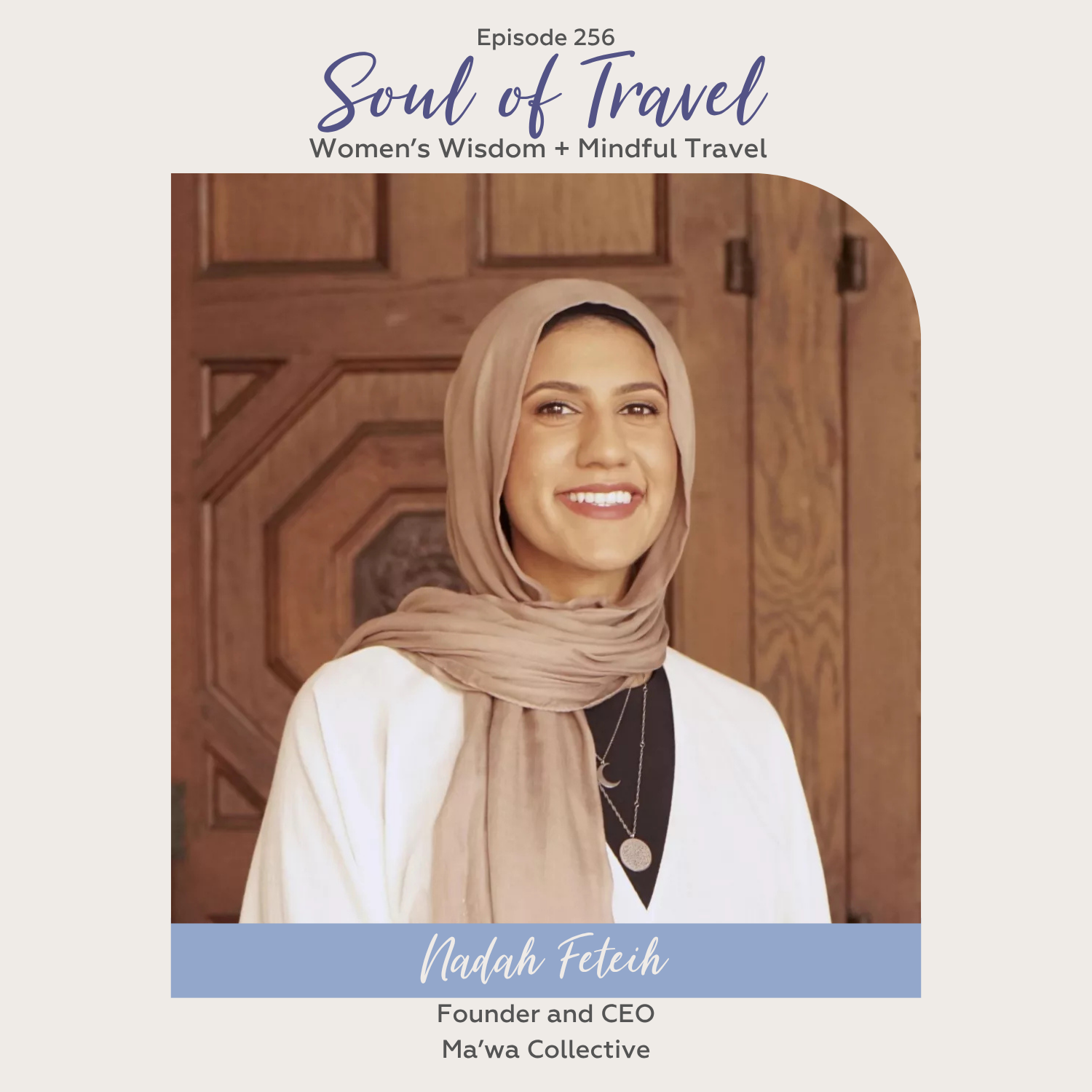
In this episode of Soul of Travel, Season 7: Women's Wisdom + Mindful Travel, Christine shares a soulful conversation with Nadah Feteih.
Words of Wisdom
“Travel is really this channel and this medium to change people's lives, and there truly is a soul to it and there's a purpose to it.”
– Nadah Feteih
Nadah Feteih is a runner, hiker, and mountaineer who grew up with a deep love for the outdoors. She is a certified Wilderness First Responder and has guided dozens of group hiking trips across the U.S. and internationally. After summiting Kilimanjaro, she founded Ma'wa Collective to make the outdoors more accessible to women in her community. Under her leadership and alongside her fantastic team, Ma'wa has grown into the largest adventure travel community for Muslim women, connecting thousands online and on the trails. Nadah's background as a Software Engineer at Google and Meta enables her to solve problems at scale and build systems that support growth. In her free time, she continues to push her limits through endurance races and high-altitude summits. She's always looking for new ways to combine her faith with her passion for exploring the beauty of Allah SWTs creation.
Discovering Adventure Travel — and Building Ma’wa Collective
Following the tech layoffs of 2022, Nadah followed the draw to climb Kilimanjaro, hardly imagining what that experience would turn into.
Within months of returning home, women in her community were messaging her asking to come along on the next adventure — and Ma’wa Collective was born.
Ma’wa (مَأْوَى) is an Arabic word that means sanctuary or a place of refuge. This is how our founder Nadah Feteih has always felt about being in nature. The ability to disconnect, appreciate God’s creation, and reflect on the beauty of the natural world has the ability to rejuvenate our souls and bring us closer to one another and our faith.
In two years, we've grown to 62+ group trips, 1240+ participants, 6,100+ members, and 67k+ followers on social media.
Join the largest travel & adventure company for Muslim women. From weekend trips to international adventure, we organize unforgettable experiences centered around faith, exploration, and self-discovery.
We look forward to seeing you on our next adventure inshaAllah.
The more Nadah learned about business and growth, the more she recognized that different perspectives are important, but leaders must stay committed to the intention and goals that had them get started in the first place.
“When you have this internal compass, you can always go back to that and say, is this still in alignment with that point?” Christine adds. Nadah shares that decision-making is an ongoing process and while the bottleneck continues to be execution, focusing on one thing and doing that well is paramount.
The proof of the ongoing impact of Ma’wa Collective goes far beyond the trips. Nadah shares that one group that trekked Patagonia together went to Guatemala on their own months later; they messaged Nadah to say the trip had changed their lives. "That is truly where I feel like the impact is," she says. "It's an oversimplification to just call it a travel company."
Resume Virtues Versus Eulogy Virtues — and the Power of a Non-Linear Path
Nadah's career path — from computer science undergrad to Meta engineer to Harvard fellow to adventure company founder — doesn't resolve into a predictable sequence. She has made peace with that, and more than that, she has come to see it as a source of strength.
Drawing on a concept she encountered in a podcast, Nadah distinguishes between resume virtues, or the credentials and titles that signal conventional success, and eulogy virtues: the qualities and choices that define the legacy you actually want to leave. For her, the decision to step away from tech and build Ma’wa was one that followed her core beliefs. "For me to have made that decision to leave tech for some time, I knew that there could be thousands of other software engineers, but how many other Muslim women could be running adventure trips like this?"
Nadah sees herself as a visionary and is candid about the ongoing practice of staying focused. But she is equally clear that for people wired the way she is, an interdisciplinary or portfolio career is a reflection of following what actually gives you fulfillment. "You've been successful in all of those things because you truly only chose opportunities that really aligned with your value system," she shares.
Her message to others navigating similarly winding paths: stop asking whether it maps to your degree and start asking what kind of world you want to have helped build.
The Barriers Muslim Women Face in Outdoor Spaces
Christine and Nadah explore how representation in the outdoor industry is about more than seeing yourself on a trail (or in advertising!). Nadah is candid about the layers of friction that Muslim women encounter when entering outdoor spaces. First, finding adventure and travel clothing that is both modest and functional is an ongoing challenge. "There's just so many extra hoops to jump through and hurdles when you decide to do this as a visibly Muslim woman," she says. Early on, those micro-barriers are enough to turn people away entirely.
Community and shared stories are the antidote – always.
The rise of Arab and Muslim running clubs, Nadah says, are a direct response to a sport and an industry that has not historically made space for them. When she takes a group of twenty visibly Muslim women onto a trail, even she is struck emotionally by the sight.
Christine connects this to her own experience of being told, years ago, that fly fishing gear wasn't made for women, a comment that closed a door she regretfully never opened again. The outdoor industry, they agree, has a long history of telling certain people in so many different ways that they don't belong here. It’s time for brands, industry professionals, and leaders to do more, and more actively inclusive practices.
There is a particular kind of visibility that comes with being the only one in the room; Nadah knows it well.
At outdoor industry conferences, on trail running routes, at her own university graduation, Nadah has repeatedly found her image used to signal diversity in spaces where she remains singular. A photo taken of her asking a question at a panel ended up on the front page of a conference website. A selfie with friends at her master's commencement has been on the UC San Diego website for years. "You do end up... there's this kind of performative aspect to it where there aren't a lot of us there, but they like to put us in those spaces where we are visible to encourage others," she says. "But it's not really a representation of everybody else in that space."
Nadah doesn’t let this be a barrier, but instead chooses to be direct about what would actually move the needle. She speaks of supporting programs that lower the barrier to entry, providing financial resources and gear access, and building community infrastructure for women who want to be in these spaces but face real obstacles getting there.
Travel as a Bridge and Bringing Muslim Women to Non-Muslim Destinations
Like so many Soul of Travel listeners and guests, for Nadah, travel has never been about checking destinations off a list. It has always been about what the experience enables: the people you meet, the things you learn about yourself, and the work of changing how others see you.
She designs Ma’wa trips to foster a space of peace and welcoming where women can feel connected, especially after spending multiple days together.
“ I think naturally the way that it started and continued as a Muslim woman majority space, is really important because you know that you'll naturally have the same sort of life experiences, the same values and beliefs and struggles. And there's always things that you can talk about with someone who you maybe just met yesterday because you've lived the same realities, just in different regions and different locations, and maybe you're just at a different phase of life.
Ma’wa trips are deliberately positioned outside the expected. Nadah takes her community to adventure destinations, like Patagonia and Ecuador, where Muslim women are rarely seen and rarely expected. "A lot of Muslim travel companies go to Muslim countries, but we take Muslims to other adventure destinations," she explains. The visibility is intentional. Every interaction on a trail, every conversation at a trailhead, is an opportunity to expand the picture of who Muslim women are and what they are capable of.
Christine shares her own formative experience visiting a mosque in Oman — an encounter that dissolved years of inherited assumptions in a single afternoon. That kind of direct human connection, Nadah says, is precisely what combats the fear and misinformation that feeds prejudice. "I always say that I choose to be a visibly Muslim woman because I care so much about my faith and my belief in God — but also because maybe something that I do will enlighten someone or share a positive representation of what our faith is like."
Travel, for Nadah, is "really this channel and this medium to change people's lives, and there truly is a soul to it and there's a purpose to it."
Soul of Travel Episode 256 At a Glance
In this conversation, Christine and Nadah discuss:
· Building cross-cultural understanding through adventure travel
· Resume virtues versus eulogy virtues — and how a non-linear path in life can be a source of power
· The barriers Muslim women face accessing outdoor spaces, from modest performance gear to representation in the industry
· What authentic inclusion in travel looks like
Join Christine and Nadah Feteih now for this soulful conversation.
LOVE these soulful conversations? We rely on listener support to produce our podcast! Make a difference by making a donation on PayPal.
Related UN Sustainable Development Goals
Sustainable Development Goal #5: Achieve gender equality and empower all women and girls.
Resources & Links Mentioned in the Episode
Visit Ma’wa Collective to learn more and support Muslim women in a unique adventure community rooted in faith, exploration, and self-discovery.
Special thanks to Strictly Jane Austen Tours for your partnership in the production of our Trailblazer Series!
About the Soul Of Travel Podcast
Soul of Travel honors the passion and dedication of people making a positive impact in the tourism industry. In each episode, you’ll hear the stories of women who are industry professionals, seasoned travelers, and community leaders. Our expert guests represent social impact organizations, adventure-based community organizations, travel photography and videography, and entrepreneurs who know that travel is an opportunity for personal awareness and a vehicle for global change.
Join us to become a more educated and intentional traveler as you learn about new destinations, sustainable and regenerative travel, and community-based tourism. Industry professionals and those curious about a career in travel will also find value and purpose in our conversations.
We are thought leaders, action-takers, and heart-centered change-makers who inspire and create community. Join host Christine Winebrenner Irick for these soulful conversations with our global community of travelers exploring the heart, the mind, and the globe.
Subscribe & Review on Apple Podcasts
Are you a Soul of Travel subscriber? Click here to subscribe to Apple Podcasts, so you don’t miss the latest episodes!
Listener reviews help expand our reach and help us rise up the ranks! Rate and review your favorite episodes on Apple Podcasts or your preferred podcast app.
Credits. Christine Winebrenner Irick (Host, creator, editor). GUEST NAME (Guest). Original music by Clark Adams. Editing, production, and content writing by Carly Oduardo.
Learn more about Lotus Sojourns
Looking for ways to be a part of the community? Learn more here!
Find Lotus Sojourns on Facebook, or join the Lotus Sojourns Collective, our FB community for like-hearted women.
Follow us on Instagram:@souloftravelpodcast and @she.sojourns
Soul of Travel Episode 256 Transcript
Women’s travel, transformational travel, sustainable travel, women leaders in travel, social entrepreneurship
Christine: I am very, very happy to be welcoming to the podcast Nadah Feteih today. She is the CEO at Mahwa Collective, and we met about a year ago at the Adventure Travel Trade Association event here in Denver, Colorado. Luckily, I had the good fortune of sitting at your table during one of the very first events.
It was a pre-event connection socialization. We sat down, everybody was introducing, and pretty quickly we had a, a great conversation. A friend of mine, Eleanor Fish, was also at our table, and honestly, I walked away from that table and that conversation just filled.
Like, I was like, if the event ended right now, I'm feeling pretty happy about it. And, um, you know, talking with people throughout the weekend, they're like, "Have you met anyone new or interesting?" Um, I probably name dropped you, I don't even know, way too many times. Um, but I just was so excited by your passion.
It was really fun to meet you and hear about your background and at that time, I feel like, and you can correct me if I'm wrong, but you were pretty new into the industry in that moment, and also seemed like you were just, um, like on fire and taking off, and it was very, um, it was just really, really great to be with you in that moment, and it's been fun to watch you over the past year, and I'm very happy to have you here to be able to share your story, so thank you for joining me.
Nadah: Yeah, thank you for having me. I'm excited to be here
Christine: Thank you. Um, well, I wanted to share, um, as I mentioned, this is our Trailblazer series, and why I wanted to have you here is to recognize your commitment in intentionally amplifying underrepresented voices and particularly Muslim voices within the tech and adventure travel space. Um, I really see you fostering great, great equity and representation and belonging, and your leadership really feels like it's ensuring that there is going to be broader diversity of perspectives reflected in the future in those industries, and I wanted to celebrate that in your work
Nadah: Yeah. Thank you so much. It's been a whirlwind, um, working in two very different industries, tech and travel and adventure, but it's been a, it's been a journey to say the least.
Christine: Yeah. Um, and also before we begin our conversation, I did wanna just take a moment to acknowledge, um, the loss that you've experienced in your community this week in San Diego, and really deeply express my gratitude for you making time for this conversation. Um, I know that open dialogue is really important to you, um, as well as celebrating how travel can create these cross-cultural connections and foster understanding.
So I know that it's hard to be here, but important to be here, and I just wanted to, to recognize that.
Nadah: Thank you so much. Yeah, please keep our community and the families affected in your thoughts and prayers. Um, the attacks on Monday, completely unprecedented. We never would've imagined this would happen to us, to people that we know that are so involved and that are truly men of service to the community.
But, you know, we're keeping them in our hearts and continuing their legacy. And so we're all kind of trying to play a part in, um, serving our people in different ways.
Christine: Yeah. Thank you. Um, well, to begin, um, Nada, I would just love to give you the opportunity to introduce yourself and tell our listeners a little bit more about who you are and, um, a little bit more about MAWAA Collective
Nadah: Yeah. Uh, my name is Nada. Uh, my background is in, uh, engineering. I studied computer science for my undergrad and master's, and I've been working in tech as a software engineer for a number of years. Um, I really discovered the outdoors and adventure travel kind of by accident. I was unfortunately part of the mass tech layoffs that were at the end of 2022.
Around that time, I was really getting into, um, being more active outdoors. I had started running a year prior, and I ran my first marathon. Um, and I realized I loved running because I love being outside. And, uh, after I kind of reached that first goal of mine, which was finishing a marathon, I wanted to translate that into other big goals that I had, and those were mainly around big treks and summits.
I just love being in the mountains, and I love how it makes me feel and the connection I feel like I have to my faith too, just being outdoors. And so, um, I had that time off. I had a severance package, so I wasn't really looking for work at the time. Uh, and I just really enjoyed the time I could spend, um, traveling as much as I could without having, you know, uh, to worry about finding a job, um, at the time.
Uh, I did Mount Kilimanjaro a couple months afterwards, and that was like pinnacle. That was when I was, like, hooked on all of this. And so I fell into adventure, adventure travel, doing these big treks. And I came back home two months later and immediately was like, well, there's all these girls that would message me when they saw my adventures and would wanna come with me.
And so that quickly translated into, you know, let me see how I can organize this for others too. So I, I was very prematurely started doing all this and then took others with me. And so it's been around three years, uh, since I've been doing adventure travel and then taking others with me.
Christine: Yeah. Um, thank you for sharing that. I think it's interesting how many people turn to travel to heal in times of transition in their lives, or just to reconnect with the parts of themselves that often get lost in the shuffle of living our daily life. And I think even more so, like you said, in nature and on a trail, on hiking, like there's just something about that time with yourself that really allows you to discover new things.
I mean, you... I, I'm sure many listeners can relate, like the step, step, step pace where you can't escape yourself,
Nadah: Mm-hmm.
Christine: um, and the way then things just kind of start unraveling. And then also, like you said, the, the goals that you can set, especially in adventure travel, to really challenge yourself and then get to know yourself as the person who can achieve these goals.
Like, I think there's so much value in this space in terms of personal growth and development and, and like this inner journey as well.
Nadah: Yeah. It trains your mind just as much as your body. Like, I've been running, uh, hiking, mountaineering, and recently trail running. Um, and just this morning I had a trail run, and it was really warm already in San Diego by, like, 9:00 AM. And so it's like you want to stop. Like, this is not always gonna be something that's very comfortable, but you just kind of tell yourself, like, "I can go an extra .2 miles.
I can go a half mile. I can..." You know, and you realize that all the moments that you really wanted to quit, you didn't need to. And those are things that stick with you, whether you're running or hiking later, or you're pursuing another thing that's challenging in your life, as you build, like, that mental toughness and that resiliency that really carries you
Christine: Yeah. And you mentioned, you know, that people were following along in your initial journey, reached out and, you know, wanted to be able to follow in your footsteps literally and figuratively. And, um, that, that kind of inadvertently led you into the next step to create this adventure travel space for Muslim women.
Um, I, I wonder, you know, as you were kind of moving into this path, was it something that you kind of jumped, like with both, in with both feet? Or, you know, it, it found you, and I wonder how responsive you were to that discovery.
Nadah: Yeah. You know, hindsight is 20/20, and I always say I was a little young and naive, which sure has, it's served me well. Um, I think the older you get, the more you think about a lot more before deciding to do anything. Um, but I've always kind of... I don't know if I would say I've been a risk-taker. I'm the middle child.
I always say I'm a stereotypical middle child where I kind of fly under the radar, don't have as much responsibility. I'm not really a rule follower like the oldest. And so, um, I had the idea and I just ran with it, and it was a half-baked idea. And I, uh, always say, like, we were building the train tracks as the train was running, and I really had no idea what it would turn into other than the fact that I, I really follow my gut a lot, and it felt like this was something that was needed, and I knew that it was solving a problem in the community, and it was something that people wanted.
And so I thought, "Let me just put this out there in the world and then see what it becomes." Um, and just being really authentic to the mission and vision that I had with it. Um, the more I learn about business and growth and just creating something and serving other people, you're gonna have a million different perspectives that are coming in and people wanting different things, and how do you stay true to, you know, what you wanna create and creating in a way that's sustainable?
Christine: Yeah, and I think that really comes from this place where you've created something for yourself first, right? And then other people with similar needs found you, so then you can always use that as your checkpoint and your compass, you know? And it's-- I do think it's hard when you ha- when you have a new business and if you're new to an industry that you wanna take everybody's perspectives into account, and you think, "Well, they've been doing it for 20 years, that's probably the right way."
Uh, it's easy to be led astray, but when you have this kind of internal compass, if you can always go back to that and be like, "Okay, is this still in alignment with that point? Yes." Then I'll, you know, I'll try it out and see. But how hard has that been for you to just use that as your guiding point, or has it been easy because it's such an internal part of your own journey?
Nadah: Uh, in terms of deciding the direction I'm gonna
Christine: Yeah, and just to make the bigger choices or to not be influenced by people that maybe have more experience
Nadah: Yeah. Uh, it's, it's an ongoing process and something I'm still working on. I really consider myself this visionary where I have a million things that I wanna do at ev- ev- any given point in time, and the bottleneck is always, like, execution. Like, how do I do all the things that I wanna do? But the more that I speak with mentors and just friends that are entrepreneurs too, it's, you know, really successful businesses and ventures and things that you start, uh, are successful because they really focus on one thing and they do it well.
And, uh way that I don't wanna give up, but I'm trying to find a way to kind of balance all of it and to understand that, you know, there's gonna be different periods of time where maybe you focus on different things. So the last two years were really just the proof of concept of this is something that people want, and so we scaled really quickly.
And last year we ran 30 group trips with over 800 women traveling with us, uh, which is a huge number for our second year. Um, but now I'm kind of slowing it down and refining it to kind of see are these, you know, what are the specific experiences that we wanna keep, um, even if it is like a smaller scale.
And so I don't think there's ever gonna be one blanket solution for what you're trying to create, but there may be different periods of time where you're optimizing for different things.
Christine: Yeah. Um, I love too that idea of the visionary and the execution, 'cause I feel like all the time I'm similar. Like, my brain is always spinning and there's a million ideas and I'm like, I wish people could just st- like, stand behind me and catch them and execute them. Because I love the generation process and the starting process and this, like, building and imagining.
But then similarly, like, the execution or picking the one thing and, and staying with it can be harder. So I, I appreciate the, uh, the challenge of that when we think so many things we could offer.
Nadah: Yeah. Yeah, and I need to be reminded of that all the time from, like, my mentors and the people that care about me and the success of this, you know? And I'm like, I need to, like, have a plan and stick with it and not be as easily influenced, even though it's all coming from a good place and you have good intentions with it
Christine: Yeah. Um, well, this, uh, kind of moves well into one of the things that I had seen you write about on LinkedIn about a resume list versus a eulogy list, and kind of how we think about ourselves and especially as people who love to learn and do a lot of things. Um, sometimes it can lead to us having kind of this scattered non-linear resume that maybe on paper doesn't look as valuable, but in reality it's creating a person who's tremendously valuable, but it's not, I don't think, fully, um, embraced in our society.
Like, we're still in this mode of the way things should be and the steps you should follow, and long-term career paths are really celebrated versus people that can actually pivot a- and adapt and morph and switch. People still kind of categorize them as maybe flaky or unambitious or can't commit, but really they're these incredibly versatile, agile, smart people.
Um, so those are kind of two slightly different buckets, but I think they interweave. I would love to first start with this idea of kind of a resume versus a eulogy list, and you and I talked about this as, um, before about, like, how you wanna be perceived and remembered and the way that you want to live because of that.
And I was sharing with you that I often think, like, you know, what would my daughters say if they were giving a eulogy about me, or even if they were just telling their friends about what's the work I do, um, you know, what, what are they inspired by? I often think, like, what do I want them to be saying?
What is that I-- what is it that I wish they would see in me, and are the actions I'm taking what they're... You know, are they witnessing that in me? And so I think that that, like, really allows you to live in a different way, and it really allows me to know that if at the end of the day, this is how I wanna be remembered, I'm gonna make this choice versus lining something up for my resume.
And I would love to hear from you, like, how this definition or redefinition for you helps, helps you to move forward in your life.
Nadah: Yeah, yeah. Yeah, and I heard that concept in a podcast I was listening to, and, um, uh, that psychologist that was giving that podcast was a musician for 20 years and then went and got his PhD in psychology from Harvard. So same sort of, um, uh, archetype and personality type, um, called them strivers. I think there's just certain people that naturally and innately like to do different things and just, I, I don't know, I just feel like I get bored really easily, and I've always had that tendency to want to do more and to think very expansively.
And as a Muslim and Arab girl who, you know, there are a lot of stereotypical paths that you can take that are kind of pushed on you or you kind of see in your community. They just never fit for me, and so it was always a constant internal struggle of, "Okay, should I be living like this, making these unconventional decisions and choices?
Like, how are other people gonna react? Is this okay? Is this right?" It d- it feels off, right? Because there aren't a lot of people that are making decisions in the way this, that I was. Um, and so I really, it took me some time to, like, lean into that and to accept that, you know, these are my tendencies, and for me to be successful and happy, I have to stay true to that and be authentic to my archetype.
This is the way that I was created. This is how I find fulfillment and the skills that I've been given to have an impact in this world and to not shy away from that. And so that's the message that I try to get across to other women out there that are like me, that are similar to me, and you can kind of pick them out of a crowd.
You can always tell who is that person that, you know, is really ambitious and loves to do more, and that excites me. Like, I just love to be inspired and to be around inspiring women. So I love the concept of this podcast and even this specific series of trailblazers, because sometimes it just takes one person to push the envelope and to go down a different path to inspire others.
And I fell into it, obviously. There was always that internal struggle of trying to maybe justify it to myself, to parents, to community, and then just doing it and realizing it was not that big of a deal. Um, but yeah, I, I look at my path. You know, I worked as a software engineer at Meta for a number of years.
I was in privacy and security, and then I did a fellowship at Harvard, and then moved back to the West Coast, and then was running my adventure company. So it really doesn't make sense when I try to, like, piece together all the parts of my story, and sometimes I share certain parts of my story to s- different people.
Like, I don't really package it all up 'cause it doesn't really make sense. But at the end of the day, I think it's just, it's authentic to who I am, and this, these are the things that I choose to spend my time doing that give me fulfillment, and I feel like really lean into where my skills are and the legacy I wanna leave in this world.
And when it comes to the eulogy virtues or the resume virtues, yeah, you always have to just think, like For me to have made that decision to leave tech for some time, I knew that there was, there could be thousands of, um, of other software engineers, but how many other Muslim women could be running adventure trips like this, you know?
Like, I think if you really imagine what legacy you would wanna leave in the world and what would actually have an impact, I had to just stay true to what I felt like was my unique skill sets and positioning, and it's still not something that I can say I'm fully confident in. I have to remind myself, like I said.
Sometimes I creep back into just, this is the safer route, this is what everybody else is doing. And so it's nice to be able to speak it out loud and to kind of get a feel from how other people also perceive what I've been creating.
Christine: Yeah. Well, and it's interesting too, that sense of security, 'cause I do think a lot of people in the tourism industry are here in kind of like a second act career or that, you know, they've landed here after doing something else, and it seems like a lot of people will kind of teeter on that moment of do...
How do I not allow myself to fall back into the sure thing so that I can be here in this space? And, and it, you know, tourism is riskier in so many ways because it's such a volatile industry. Um, but I, I think it's really valuable to support one another in that, and I think we're such, especially in the adventure travel space, we're such this like motley, interesting crew because of how so many people have landed there.
Um, I think that's really helpful to, to just be like, yes, this is a reasonable choice, 'cause I, I think sometimes when it's not the socially perceived, like, right choice, it can be so hard to keep telling yourself that it is the right choice.
Nadah: Yeah.
Christine: Yeah. Um, when you look at this idea of a non-linear resume, and I wanted to talk about this too, because again, this is something that comes up a lot on the podcast about, you know, not focusing on your continuity and longevity in a position, but really the skills and relationships that you develop and how, especially in this volatile industry, like these tools that you pick up are more important than where you got them and how long you were wherever you were.
I just wanted to talk about that. Like, how do you think we could shift that into a positive instead of a negative? And you know, you've shared a little bit, but how do you think you would maybe encourage other people who are looking at this similar like winding path to really embrace the power that lies in that instead of feeling a little bit ashamed by not being in a straight line?
Nadah: Yeah. I, I just think as the world evolves and even, um, the workforce right now, there's a lot of changes in roles that we thought were very safe or standard. Like even as a software engineer with AI tools taking over a lot of what we typically did, there is nothing that is really, quote-unquote, "stable," right?
You're going to need to adapt as the world changes, as jobs change, and, you know, building those skills and building yourself and knowing what you're good at, what you can offer to the world, what makes you unique, and kind of building up that story is really important, um, because you can use those skills in so many different sort of industries or roles, and it may not be what you typically thought or what you studied and that career, career path you maybe pursued straight out of college.
And, um, I always say, like, in doing those thought exercises of what is, what is it that I'm good at or what should I lean into? What roles could I do and what's important to me? And I've always said I loved engineering and, you know, software and programming because I love problem-solving and learning new things and really like chipping away at something.
Um, and I've always loved service and community and things like that, and so somehow I've kind of packaged that up into running Adventures right now through this company. But who knows, maybe a few years from now I would piv- decide to pivot and to apply those skills and those passions in a different space.
Um, so not, like, hyper-fixating on what specific role would map to my degree right now and what I should be applying for, but just looking inward and doing those thought exercises of w-what, what sort of, like, end goal do I have or what sort of space do I wanna work in? And just staying true at the end of the day to the things that give you fulfillment, that give you peace, 'cause it's, it's gonna be really hard to kind of put yourself in a place because you feel like you should be there and you don't actually feel that pull.
Um, and yeah, that's kind of what I keep in mind 'cause, like, I- I've been so inspired by so many people that have nonlinear paths that just jump around and you realize they've been successful in all of those things because they truly only chose opportunities that really aligned with their value system and what's important to them.
Christine: Yeah, I love that so much, and I agree with that stagnant feeling that people can sit with for such a long time because they just chose a path and they're like, "That's the path I chose. I will be here forever." And I think it's so heartbreaking, especially when you know that they have talents and passions outside of that, where we're probably losing their greatest contribution just because that's been the traditional narrative.
But I also agree, I think it's changing and people are really getting more creative in who they hire and getting more creative and accepting when people show up in the room with a seemingly non-applicable skill set, but really looking at how it can translate into those actions. And I, I think it will make us, make a lot of industries stronger because you're pulling in different perspectives, which, um, you know, as you would, I'm sure, say is very important.
Nadah: Yeah, yeah, being interdisciplinary and this whole concept of a portfolio career now, which is really interesting, and I inadvertently had kind of been creating that of just having different roles or just jobs that you do and things that you care about, whether that's creating con- like I also create content online and, you know, run experiences and also do some work in tech and just all these things I love and I feel like have a different place in my life.
Um, and it just kind of makes life a little bit more exciting. There's also folks like going back to the whole staying true to the way that you are, there are some people that are so content in their nine to five, they don't want to rock the boat. That is like truly what gives them peace and happiness in their lives, and to each their own.
Like, like in the same way that we've accepted and leaned into this archetype that we are, there's nothing to judge or to change if that is the way they choose to live their lives. And so I feel like sometimes that this idea of you need to start a business or be an entrepreneur or do your own thing is really shoved down a lot of people's throats, and it's really not for everyone 'cause there's been so many times when even I'm like, "Wow, this is a lot.
You know, this is not for the faint of heart." Um, so yeah, just really understanding yourself enough to make those decisions.
Christine: Yeah, I think it's really great to live in this time too where people explore, like you were saying, archetypes and learning styles and all the different personality assessments that allow you to understand who you are in a more complete way and let that be your guiding path instead of, you know, having one or two choices.
I just think it's really interesting and not something that would have been talked about like early in my career or when I was planning to attend university and whereas now my, my kids, you know, they'll be like, "Oh, I'm-- this is my learning style. This is my way of this, this is my way of this." And their understanding of who they are and the freedom for them to explore that understanding of who they are is such a different place than I ever had the opportunity to, to experience.
Like I kind of knew these things about myself but they were really contrary to the environment where I grew up and so I constantly felt like if my internal voice spoke up I would be pushing against so many norms that I just never allowed her to take up space which in turn now is causing, you know, all kinds of other interesting growth experiences because it turns out, you know, when you silence a huge part of yourself that causes all sorts of things to unwind and so I, I just love that these conversations are, are happening, um, at this point.
But, um, one of the other things that I wanted to talk to you about that I was reading and I love these moments when I'm reading something and I go, "Oh, I've never had to think about that or I've never thought about that." Um, and the never had to think about it is usually because of a place of privilege, right?
And just never thought about it might just be I haven't crossed that in my path. But you, um, had created a program to get more Arabic speakers into AI and ML and to tech and, you know, because you didn't want that industry to lose all of that knowledge that was being lost because of a language barrier and I, you know, that's the moment I was like, oh, I have never had that thought
And I, and I also was just thinking about, you know, many other industries that have inherent barriers because of language and access and accessibility because of A variety of things, and I just thought, um, again, like how powerful that you noticed this barrier and did something about it because it's applicable to your own experience, but because you also knew the impact it would have in the greater, um, industry.
And I just wanted to talk to you about like how your personal experiences really fuel those steps that you take to create more inclusive spaces and why that's important.
Nadah: Yeah. So just to clarify, that program in particular was my brother-in-law actually created that course
Christine: Oh, okay
Nadah: on LinkedIn, but kind of falls under the same umbrella of wanting to bridge that gap between communities. And back in college, I also started a group for Muslim women in tech where, you know, we created this mentorship program and offered scholarships and just had this community to connect, uh, women to each other, um, in this industry, which was, you know, really valuable for a lot of us who struggle to see a space for us and to see representation and to have that support that we needed, um, to really pursue and thrive in our careers.
Um, but yeah, I've always kind of like never shied away from bringing my identity into the work that I was doing, whether that was in tech or in travel, um, because I... You know, it's really shocking to folks when I talk about Matwa and I say, "Oh yeah, we had 800 women travel with us in our second year. These are all women that are strangers and don't know each other, but they're signing up to go with this company that I just started."
And they're shocked. They're like, "How does this work?" And I've always just said it's really the affinity space, and it's having people that look like you, that you identify with, that speak the same language, that follow the same faith. You naturally just have this desire to spend more time with people like that, and you feel the safest with them, and having our own spaces are so important.
And so that's how it's been so successful and it's been so needed, um, in this industry, especially in the outdoors, which is not very diverse. Um, attending ATTA and Outside Days last year, you know, I saw firsthand in Denver how I felt so different, and I'm going again next weekend, um, because even though I felt different, it truly was a place that I also felt like I belonged because I love endurance sports, I love adventure travel, I love being outside.
I'm also an outdoor creator online. And so, uh, all these parts are also part of my identity, even if I don't look it. Um, so I've really just kind of stayed true to the fact that there aren't people that look like me in this space. I will still be there. Um, kind of going back into that trailblazer concept.
Um, literally, you know, it's, you know, spending a lot of time on trails where I don't see any other hijabis, and when I'm taking women on the trails, Muslim women in our community, you know, and I see like 20 women that are visibly Muslim wearing headscarf and dressing modestly, even I'm kind of shocked sometimes.
Like, I don't see that a lot, and that's kind of how we've grown organically so quickly. Um, so yeah, all of that is really important to us.
Christine: Yeah. I, well, that I wanted to talk to you about that too, the importance of seeing yourself represented and, um, that, you know, why that's so important. And again, reading a comment you said about just when you first wanted to start in the outdoor space, even being able to find the performance clothing that you wanted and needed that was modest and met your needs that didn't exist, and then, you know, realizing, you know, is this, is this a sign I shouldn't be here, or is this sign that nobody is here supporting me, I guess?
Like, you know, how important is that representation into getting more people out, out and outdoors?
Nadah: Yeah. There's just so many extra hoops to jump through and hurdles when you decide to do this as a visibly Muslim woman, you know? And I still struggle five years in to find the clothes that I- are not only performant, but they're also comfortable, they fit me 'cause I'm tall, um, and they're cute, you know, 'cause also looking good matters.
So it's just-- and they're modest obviously, so it's just, it's difficult. It, it seems like it's such a niche thing that there may never be a full solution, but you kind of live with it. You find out what works for you and you make it work. Um, but yeah, I think all of those are just like, they're like micro, uh, speed bumps in the process of, "Okay, I didn't find a scarf to wear on this run.
I'm just not gonna run." When you're really early on in your journey, those things really turn you away. Or, you know, I don't have anyone in my city to run with, like, that I'm friends with, that also looks like me, that I feel comfortable running with, I'm just not gonna run. So those things really turn people away.
That's why things like the Arab and Muslim running clubs really popped off too in the last few years. That's why all these in- affinity spaces are so important. Um, even anecdotally, like I don't have friends that really climb very much. Like, I have friends that are climbers. They do a lot of indoor climbing at gyms, but they like live in different cities, so when I go to that city, I'll go with them.
But I haven't gotten into the sport because I don't really have friends near me that do it. So there's all these barrier to entries when you don't have a community or friends that do it. And so when these sports and activities are already very rare and not very common, um, for people in your community to participate in, you aren't really encouraged to do it.
Um, and yeah, I ended up starting a running club when I was living in San Francisco. Um, and I'm far enough along now, five years, where like I just go out. Like I just did my trail run by myself this morning. I do my runs and my hikes by myself. I don't really need that support as much because I've just-- I, I've had the time to really build that foundation.
But I know how it could be something that turns people away.
Christine: Yeah. Um, just for anyone listening, I would just like to shout out that there are lots of tall women who would not like to look like a man when they're outside.
Nadah: I love that.
Speaker 3: I'm like,
Nadah: I do stop in the men's section quite a bit, unfortunately.
Christine: Yeah. Me too. Tall curvy, and they're like, "You only want to wear zip-off pants that are khaki."
Nadah: yeah, I'm 5'9", so I'm at the cusp of like sometimes I need the tall joggers or else it just looks awkward and I'm like, "Ah."
Christine: Yeah, I actually, this is a panel that I would love to put together, um, at some point. But just talking about all of these different things that women need for outdoor spaces and how hard it is to find them. 'Cause I've had a few other conversations with other, um, really inspiring people that have tackled small elements of this in the industry.
But I was talking to someone about fly fishing and I was interested in it in college and the person I asked to teach me, you know, he was like, "They don't even make fly fishing gear for women." And I was like, "What?" And again, this was like 20 years ago so it could've been true in that moment but I was like the little, you know, the person in me that, like, got the fire and I was like, "Oh my gosh, that is not okay, man."
And the way that that just, like, stopped me in my tracks immediately. I was like, "I am not welcome here. They don't even make clothes for me." Um, like, how much that actually impacted, I- can I tell you, I've never gone fly fishing. I, I never have. No one ... That moment, I didn't wanna ask again. Like, it was such a shut door for me.
And, um, I just think about that especially, you know, there's so many people who have a moment like that where they just, the, the industry literally tells them, "You don't belong here." And so sometimes I think it's hard to overcome that kind of a, that discrimination that you're feeling in that moment that, that you can't be here because you're not even able to just find shoes or whatever it is.
Nadah: Mm-hmm. Exactly
Christine: Um, well, the, one of the other things I was thinking about for you and for other women that are trailblazers is this idea of visibility that's given to you in a room when you are someone who is of a community that doesn't typically have rep- representation. You know, you were kinda mentioning that, you know, being at the Outdoor Fest and, like, how, how have you navigated that kind of, like, invisible visibility, I guess if you would wanna
Nadah: always invisible. Sometimes it is, um,
Christine: It's like hyper-visible.
Nadah: uh, uh, yeah, what's the word? I, uh, there's a word for it where it's like you become like the poster child of something because you are a person of color in the space. And, um, I'm on, uh, the Outside Days summit, like, uh, website on the front page. They took a picture of me when I was asking a question at one of the panels, and you just kind of know that's gonna make it somewhere where people can see it when I was the only hijabi there out of thousands of people.
Even at graduation, actually, when I was finishing my master's, uh, I was sitting in the front ... I somehow ended up in the front row with my friends and we were taking a selfie and we saw the photographer come by and I was telling them, 'cause we're all women of color that are in, you know, computer science.
I was like, "Guys, this picture's gonna end up somewhere." And it turns out it's been on the UCZ commencement website front page for so long. Um, so yeah, you do end up, there's this kind of performative aspect to it where there aren't a lot of us there, but they like to kind of put us in this pos- in, like, those spaces where we are visible to encourage others, I guess, but it's not really a representation of everybody else in that space.
Um, so yeah, I think it's, like you said, it's a mix of like hyper-visibility and also being invisible because you will be there and I'll look around and I won't see other people that look like me, and if I'm new to that space, like last year I can say my first few days there I was a little hesitant and I was kind of like a fly on the wall.
But at the end of the day, I also knew a lot of those folks. I was friends online with a lot of those endurance athletes, and I finally got to see them in person, or other folks that are running companies. And I mean, even the conference I'm going to next weekend with the different tracks that they have with endure and attract, like I work in travel and I also do these endurance sports, so I know I have a place there and I know the folks here.
But I also know that if they put my picture on the website, I'm the only one. Like I, I don't think that's a good representation of everybody else in that space. So I would like to hope that with this diversity that they're trying to tout, they're also really investing in the inclusion piece and making sure that they are supporting programs like the ones that I'm creating and working on building to bring more people like me outdoors, and that access really matters and support really matters to lower the barrier to entry by providing financial resources, by helping provide gear.
All these things really make a difference in getting more women outdoors and getting more women that look like me. Um, so yeah, I think that it's always been tricky to navigate, and I'm actually so curious what's gonna happen next weekend. But overall, I'm just excited to be there since I know so many of the folks that are speaking and they're also there in that space.
And even if I'm the only one, again, I know that this is just a matter of time to start getting more representation in those spaces.
Christine: Yeah. Thank you for, for sharing that. I, I would just share as a business owner and, like, creating my website and trying to be someone who wants to, like, I- inclusivity is very important to me, and yet on most of the trips, I mean, much like you, like, like attracts like. So the women that often book my trips are also, like, middle-aged white women who are interested in yoga and, you know, like, if you take that picture and then I put that picture up, that to me also is kind of saying, like, "This is the only people welcome here," which isn't true for me.
But then if I choose to put, like, a woman of color in my flyer because I want someone to see themselves and feel welcome, then it's inauthentic to the space that already exists. Um, so I, I think it can be so challenging and, um, difficult to figure out the right balance, especially if you do, if you're doing it from a place of authenticity and not a place of trying to, uh, where it's not performative, right?
Where it is that I actually want this space to look and feel this way, and I somehow need to attract more diversity in order for it to look and feel the way I want it to look and feel.
Nadah: Mm-hmm.
Christine: Yeah, I haven't figured out an answer yet, but, um, I don't know.
Nadah: Yeah, your in- your intentions are there. You just, like... Yeah, it's really hard to, especially when you're running group trips, you can't control who is signing up. It just takes a matter of time to make sure everyone feels like they're welcome.
Christine: Yeah. Um, well, I did wanna spend a little bit of time talking about sisterhood, um, with you. I know that's not a new conversation here on Soul of Travel, but I know it's really important to you and really important in the space that you're creating. Um, I think there's something unique about traveling in groups of women.
Um, and like you mentioned, I think it's also really important to travel and gather with people who have similar life experiences and have similar passions and religion and beliefs. Um, w- how do you think that has shown up for your community, and how have they responded to that?
Nadah: Yeah. Yeah. It's-- And I know we talked about this. It's really hard to describe, um, what Metwa is because it's not just a travel company. When I call it a travel company, it's very limiting, um, because when I talk to the women that end up joining our trips, you know, most of the time they're not joining for the experiences or the travel destination, but it's also for the people and the sisterhood, and just that connection that these women make after spending multiple days together.
There's something really powerful and unique about overnight experiences and how close you get with, you know, the other women that are there, just from both the shared activities and the hikes that are kind of a struggle, like you're really pushing through it together, which helps build those bonds. And then overnight we have like those reflections that we have in the evenings and we really, you know, women start to open up and to feel really comfortable in those spaces because they're aro- around a lot of like-minded people. So I always say by the last evening everyone is kind of crying and just, you know, fee- really feeling that connection with each other and that's another thing that's super powerful about those spaces and, um, I think naturally the way that it started and continued as a Muslim woman kind of majority space, um, is really important because you know that you'll naturally have the same sort of life experiences, the same values and beliefs and struggles, and there's always things that you can talk about with someone who you maybe just met yesterday because you've lived the same realities just in different regions and different locations and maybe you're just at a different phase of life.
Um, so you end up finding mentors on that trip, you f- you find friends, you just find community and, uh, the most fulfilling part has been not only those experiences that I run, but seeing the women afterwards continue to travel together. They stay really close friends and you'll see this whole snowball effect where the group that came to Patagonia with us last year, I saw that those girls went to Guatemala together a few weeks ago and they were messaging me and were just saying like, "Oh, the girls say hi," and like, "That trip changed our lives," and all of that.
So I think that that is truly where I feel like the impact is and, um, you know, feels like a little-- It's an oversimplification to just call it a travel company,
Christine: Yeah. I'm so glad that you brought that up. And for our listeners, when we were planning for this conversation, we were talking and I had shared about, um, how when I launched my company, Lotus Sojourns, I was like, "I really don't wanna call it a travel company," because for me that's, like, the least important element of the environment that I'm trying to create.
But it is how, you know, it's the vehicle and the tool for how everything is happening, and it's also the thing that people understand what you're saying when you say it to them. And so it's like if you're selling them something, they need to know what, what it- they at least think that they're buying into.
But yet it's this idea of community and sisterhood and personal growth and belonging, and all those things are the things that were so much more important to me. And being able to cultivate those as we travel was really what I wanted to do. And even when I started, I had really wanted to say transformational travel company, and again, this was like 10 years ago, and so people were just starting to throw out that word.
And, and when I would say, "I'm starting a transformational travel company," and I was like, "It's like an adventure, a mindfulness adventure retreat," and... Or I tried all the words, right? And every time would just look at me like, "I don't know what you're s- saying to me." And I'm like, "It's a women's travel company."
And even that, let me tell you, even that I have had people be like, "Just women? Why would you do that?" I was like, "Oh my gosh. Well, let me tell you, I'm not putting that part down." Like, that is what it is. But it is so interesting when you see people's responses, um, to what you're creating, and this maybe goes back to where we started, like my compass knows where I'm headed.
Um, finding language to communicate it to others is important,
Nadah: Mm-hmm.
Christine: but I, I don't have to live in the world of travel. I just am, I just truly believe travel is the important, like, piece to make this experience happen. But it's not like the overall outcome and goal of the experience.
Nadah: Exactly. Yeah. Yeah. No, 100% agree, and I didn't realize that there were those different angles that you could kind of call it a transformational travel company. I just feel like I'm never give... Like, I can't just stand there and explain what it is that I do in, like, a minute. So it's just so hard to be able to convey to people.
Um, so yeah,
Christine: Yeah. I always joke that my business card like folds out like this
Nadah: yeah, yeah.
yeah.
Christine: because I want all this time. And the first travel show I went to to present my company, like I would just sit there and I'm like, "Her, she needs this. I can just see it." And I'm like, "But I don't know..." I, I just wanted to go up to them and be like, "I know that this is what you're looking for while you're walking through all of these booths, and you're not seeing me yet, but I know this is what you're looking for."
And then I even had a few like partners of women come up and say like, "Oh my gosh, I think this is what my wife needs. Tell me more what you
Nadah: Oh yeah, the
Christine: And then they would run and grab 'em and like drag 'em over, and I'm like, "Oh, yes, this, that's... I mean, that's it. That's the thing." But it, it takes a little bit more time, and like the connection's important, and it doesn't come in one word or one phrase or one elevator pitch.
Nadah: Exactly. Yeah
Christine: Um, well, before we end our, our conversation, I, I also wanted to just talk about the importance of travel as a tool for cultural understanding and, um, and I wanted to share a little bit about, you and I also talked about this in our, in our pre-trip conversation, and I think it's so relevant to the moment that you're in.
Um, you know, growing up in the US, I grew up in a, a very small town in rural Montana that was about as like cohe- or not cohesive, uh Everyone was the same. There was very little diversity. Uh, there was very little talk of diversity. I swear that my, like, books and language and every- like, I felt like everything was almost like a, uh, movie set in terms of diversity.
And I remember even when I was little going like, "I wanna move somewhere that has culture." And my whole family looking at me like, "I have no idea what you're saying." But I was probably kind of, you know... I, I just was always thinking about and pushing against the, those boundaries. Like, I just recognized that what I was experiencing wasn't the full picture.
How I knew this, I have no idea, but it just was inside me, right? Um, and I was sharing with you at one point, I was able to travel to Oman and, um, at the time we were traveling... Well, I guess at any time when you're traveling there's tumultuous things occurring in the Middle East, and there's all of the, the ways that we are taught to think about that region growing up, which I didn't believe to be true, and yet, like, it's the bubble I was raised in.
And I was nervous about being an American woman there, uh, how I was going to be perceived. I wanted-- I was so aware of wanting to be respectful of the place that I was in, but I felt so unsure of how to make any move. I just was like, I want... I was, like, hyper respectful, which r- like, made me actually just, like, be an idiot.
I don't even know. I was so nervous. And I had this experience that I shared with you where we went to a mosque And as we walked up, I just was in such awe of the beauty of this building. And when we entered the space, I, like... All I remember is, like, this, like, white silence. Like, it was so beautiful and so peaceful.
I don't know if it was my internal state or the external state. Um, and we met this man, and he said, "I would like to share with you the process I prepare to, prepare to enter the mosque, and I would like to take you in and show you, and I would like to, you know, read my, my favorite passage to you." And he was so gracious and welcoming.
And again, this was a whole group of women, so I was like, "Is this okay?" I was so n- tentative. And when we entered that room, I will tell you that it is the greatest sense of connection to spirituality I've ever felt in my entire life. I will try to get through this without crying. I did not get through that without it, because it was such a beautiful and profound experience.
And then him reading to me, again, I was moved to tears, and all I could hear was like, "Well, that's what I believe too. That's how I see the world. That's exactly the same as me. That's so incredibly beautiful. Um, everything I've ever been told to believe about you is not true."
Nadah: Mm-hmm.
Christine: And it has stayed with me for 20 years now, like, in such a way that I can hardly get through the sentence.
And to me, I think that is the profound power of travel, to have a real experience with another human who's authentically sharing themselves with you, which now, like, erases anything that else that somebody tries to tell me as, like, a blanket statement about a whole entire culture. Um, and I just wanted to talk to you about the ways in which travel shifts perspectives for you or for others, or the way that you've seen it kind of create a place for conversation where it didn't exist.
Nadah: Yeah. Yeah. Thank you for sharing that story. And, uh, I visited Oman for the first time in January, and the mosques there are so beautiful, and just travel in general is so important to build that bridge and to cultivate that understanding and share the reality of what different religions and cultures are, are like and how different people live.
And Islam truly is a religion of peace. It means peace and submission, and a lot of the hatred, um, and a lot of the things that are spewed online and in the media are just coming from a place of just completely false narratives and a lot of fear mongering, and it's just so wrong. And these also are coming from a lot of online resources and things that are just incorrect.
And if you've never interacted with another Muslim, it is no surprise that this is maybe the stereotypes that people are seeing, and that's why racism is so rampant in this country right now. And so even as us groups of Muslims that are traveling together, we are sharing more, whether explicitly or implicitly, about who we are and the way that we act in public.
I always say that I choose to be a visibly Muslim woman because I, I s- I care so much about my faith and my belief in God that that's why I choose to wear it first and foremost, but also because maybe something that I do will, uh, enlighten someone or share a positive representation of what our faith is like.
A lot of people that have even met one other Muslim in their lives, you know, would change any sort of perspective that they thought of what Islam was from the media. And so we meet a lot of people that have never met a Muslim before when we're out on the trails or when we're traveling. Um, we don't do a lot of travel in Muslim countries, but it's more of bringing who we are to other parts of the world where we also should feel included and welcome.
Um, but at the end of the day, there's also a lot of adventure travel, you know, in the Middle East, and those are destinations that we're considering. Um, but a lot of bigotry and hatred just comes from never interacting or never knowing or never meeting someone that looks different, like you said, growing up in that small town in the US, um, and just being fed all these false narratives.
And so, um, the little corner that I've chosen to kind of spend my time and energy into and building these experiences for women in my community is not just to serve them, but also because the space is just so not diverse that if I'm even here and chipping away at it and being that one Muslim that folks at this outdoor conference have ever met, you know, then maybe I've done something that's meaningful and that will kind of...
There'll be a domino effect at some point. Um, and so continuing to be there in those spaces, um, and to bring other people with me.
Christine: Yeah. Thank you. And I just imagine, you know, for me, you know, there's moments when I'm like, "Okay, I wanna be an outspoken feminist," or, "I wanna be this and be visible," but I have the ease of disappearing when I want to, and that because of your choice that people can always easily identify who you are, that you don't have that ability to disappear when you might want to.
I can imagine, you know, there's some level of, um, pressure that there's always eyes upon you making that association, whereas I can, I can escape that if, if I wish. And I just-- I've been thinking about that a lot as I've been preparing for this conversation with you. And, um, I don't know. I just want to share that I recognize that that is a weight that you bear, and, um, I'm, I'm grateful for the way that you have stood up for your community and for what I've seen, and, um, I'm always really inspired by people that, that make that choice.
Nadah: Yeah. Thank you so much, Christine. It means so much
Christine: Um, okay. Well, now that I'm like I'm like, I try to end and begin happy, and now I'm very emotional, but that a lot here because I want to be true to who we are as humans, humans are emotional, right?
Nadah: Mm-hmm.
Christine: Um, you-- I have two things. I have my rapid fire questions, but I also wanna give you a quick moment to share about your trip, um, to Patagonia in December.
I know that you are running, um, in case anyone's listening to this and this is the group that they're looking for traveling with.
Nadah: Yeah. That trip sold out really quickly too, and so we've, uh, um, yeah. But yeah, this is our third year running Patagonia, like I mentioned. We just... There's a lot of Muslim travel companies that go to Muslim countries, but we take Muslims to other adventure destinations, and so Patagonia has been one of those destinations we're excited about.
Christine: Yeah. Well, congratulations on that. Again, like I said, I just am, um, so inspired by your success, and it just says how much you are speaking to the right people and to a need that exists. So I'm, I am very, very excited for what's to come for you. Um, okay, rapid fire-ish questions. Uh, what are you reading right now?
Nadah: Ooh. I'm actually reading a book called Breathe that was recommended to me by a trail running coach. Um, just talking about how, like, as a species we've forgotten how to breathe properly and how it just changes your entire quality of life, and I'm also just training for an ultra-marathon and I just feel like my training's been all over the place and I'm just
My heart rate and stuff, and I'm still working on bringing it down. So I'm learning how to breathe properly. I know it's a random book.
Christine: I think I'm looking around my office waiting to see where it is. I purchased that book that I have not read yet. Um, but I also feel like I need to relearn how to breathe. Um, what is always in your suitcase or backpack when you travel?
Nadah: Hmm. Other than like the classic like phone, wallet, keys, all that stuff, passport, um, I always have, um, I have my, my Quran, so that's basically my, the holy book that we read. Um, I also always bring my Kindle with me. I have a lot of books on that too. Makes it easy. And my prayer beads, uh, that's something that I always travel with. Um, besides that, I always have my running shoes 'cause I'm always running wherever I'm going.
That's kind of why I picked up the hobby, 'cause I'm traveling so much. Um, running and training and traveling is very hard, but I try to make it work
Christine: Yeah. Thank you. Well, I've seen, uh, definitely ATTA, that's always such a good one to go to 'cause there's so many people that get up and run before they go to all of the, the events, so, um, what is something you eat that immediately connects you to a place you've been?
Nadah: Ooh. I just messaged a friend yesterday. I sent her a reel that I found about plantains. Um, I love plantain chips, and it just reminds me of some of my travels in South America. It's like, it's just like, it's kind of like normal chips that you buy, um, at some of those little shops. But I just love plantain chips.
It reminds me of my first trip to Ecuador
Christine: Yeah. I've tried to make them as well. Luckily now you can buy them in US, but bef- you didn't used to, and I tried to make them and they were so bad. I was like, "Oh."
Nadah: yeah
Christine: Um, who was a person that inspired or encouraged you to set out to travel the world?
Nadah: So the person that first kind of nudged me to do some of these big treks that I wanted to do, and I would say I always travel just for objectives that I have. I don't just travel to visit every single country in the world, but it's always around the mountains that I wanted to climb. Uh, but Tima Deryan, I mess- I-- she's a Lebanese mountaineer, and I just randomly listened to a podcast that she was on before I kind of started my running and traveling journey, and I remember something about that podcast just really stuck with me.
So I found her on Instagram afterwards, and we messaged a little bit, and I talked to her. So meeting another Arab mountaineer had meant a lot, and she made the time to talk to me. And then, um, that was kind of, like, around the time I started taking my hobbies more seriously, and so I always remember that conversation I had with her.
Christine: Yeah, that's great. I'm so glad that, that she responded, 'cause I know sometimes you
Nadah: I know. And I think about that now too of like, you know, sometimes you just get flooded with messages and I'm like, "What if I'm not responding to someone that also wants to talk now?" And so we try our best
Christine: Yeah. Um, if you could share an adventure with one person, fictional or real, alive or past, who would it be?
Nadah: Share an adventure. Oh Oh, that's a hard question. I feel like I can't think of this off the top of my head. Hmm
Christine: That's okay. If no one pops to mind, I can skip to the next one and you can share later if it comes up.
Nadah: I guess on the same note of the Arab mountaineers that I've met, Omar Samra is another one that I've really admired just 'cause he's also built a adventure company and he posts a lot of, and he shares a lot more about his, uh, personal growth and his journey too in climbing the mountains, and he was the first Egyptian to summit Everest, and I'm also Egyptian and I've kind of connected with the community there.
That would be a lot of fun to go on adventure with him after everything that he's done in his life, um, and to just kind of get to know him more
Christine: Yeah. Um, when you think about the soul of travel, what does that phrase mean to you?
Nadah: Hmm. I always think of, like, the purpose of travel, like it's a means to an end. It isn't the objective in and of itself. Uh, for me, travel is always just a tool, right? I think we talked about this. It isn't really the thing that I'm aspiring to do. I'm not country counting or I have this bucket list of all the places I just wanna check off, but it's really what this enables, who this allows me to meet, the things that I've been able to learn about myself, the people that, whose lives I may have changed by allowing them the opportunity to travel to these places for the first time.
And so I think of how travel is really this channel and this medium to change people's lives, and that there truly is a soul to it and there's a purpose to it
Christine: Yeah. Thank you. Um, and the last question, Soul of Travel is a space for recognizing women in the industry. Who is one woman you admire and would like to acknowledge in this space?
Nadah: Ooh. I'm gonna go down the track of Arab mountaineers too because Nelly Attar is another really incredible Arab mountaineer. First Arab to summit K2, not to mention all the things that she's done to also empower women through the dance studio she started in Saudi Arabia. Um, but yeah, I feel like I just love following their stories because I see a part of myself in them.
You know, I'm Egyptian American, so I'm born and raised here in the West. Um, but still seeing other women that come from the same culture and identity and seeing the things that they've done. She's incredibly strong, incredibly ambitious, and just, she's done so much, and I really admire everything she does and continues to do.
Christine: Thank you. Um, and thank you so much for being here. I'm so glad to have had this conversation and to be able to share more about the work that you're doing and, um, really grateful for, for the conversation
Nadah: Thank you so much, Christine. Have a great rest of your day. And yeah
Christine: Hey, listeners, it's Christine, hopping in to take a moment to share some big news and talk about a new supporter of the podcast Those of you who have been enjoying these soulful conversations for the past few years may know that I have almost entirely self-funded this program. I am so happy to announce that we have a title sponsor for this special trailblazer series.
Before I share who they are, I want to share why I'm excited to work with them. When you are on this side of the screen and the mic, often alone, you never truly know where your work will find itself, who it will impact, and the changes it may influence along the way. I am always truly happy when a listener reaches out to share what they love or whose voices have inspired them.
It's even more exciting when they really see the work you are doing and understand why it is important. I am a believer in the threads that weave us together and the magic of the universe, and I love a synchronicity that connects people. Today, I'm delighted to introduce you to Teresa McDermott and Strictly Jane Austen Tours based in Bath, England.
She reached out recently sharing how inspired she is by Soul of Travel, and after listening to my last recorded episode where I'd asked for financial support to carry the podcast forward, Teresa wondered how she might stand beside me and the inspiring women featured on this podcast. We immediately connected and had a wonderful conversation, and I shared about this series about women trailblazers in tourism and the outdoors, and how I would love to highlight the work they are doing to get more women outside, traveling, leading tours, becoming storytellers and wisdom sharers through the work they do.
As I shared, we immediately saw the overlap between the energy and work of these women and the trailblazing work of Jane Austen. So side by side with this podcast series, I'll be sharing some of this exploration into Austen's work and the overlap we see. I think it's going to be a fun way to share more about Teresa's vision for Strictly Jane Austen Tours and why she believes that the platform created by Soul of Travel Podcast is important today.
If you'd love to learn more about Strictly Jane Austen Tours and their unique immersive tours they are designing that give you a glimpse of the real Jane Austen, be sure to visit strictlyjaneausten.com. And calling all Jane Austen fans, for every two bookings you make for Strictly Jane Austen's 2026 annual celebrations, each guest gets a free Regency style costume hire for the full six-day event plus a signed book.
You just need to act fast and quote Soul of Travel when you book. and get in before the 30th of June. I'll be sharing more about Strictly Jane Austen Tours during this special series. For now, let's hop back over to our soulful conversation
You can find me on Facebook at Lotus Sojourns on Facebook, or join the Lotus Sojourns Collective, our FB community, or follow me on Instagram either @lotussojourns or @souloftravelpodcast. Stay up to date by joining the Lotus Sojourns mailing list. I look forward to getting to know you and hopefully hearing your story.