
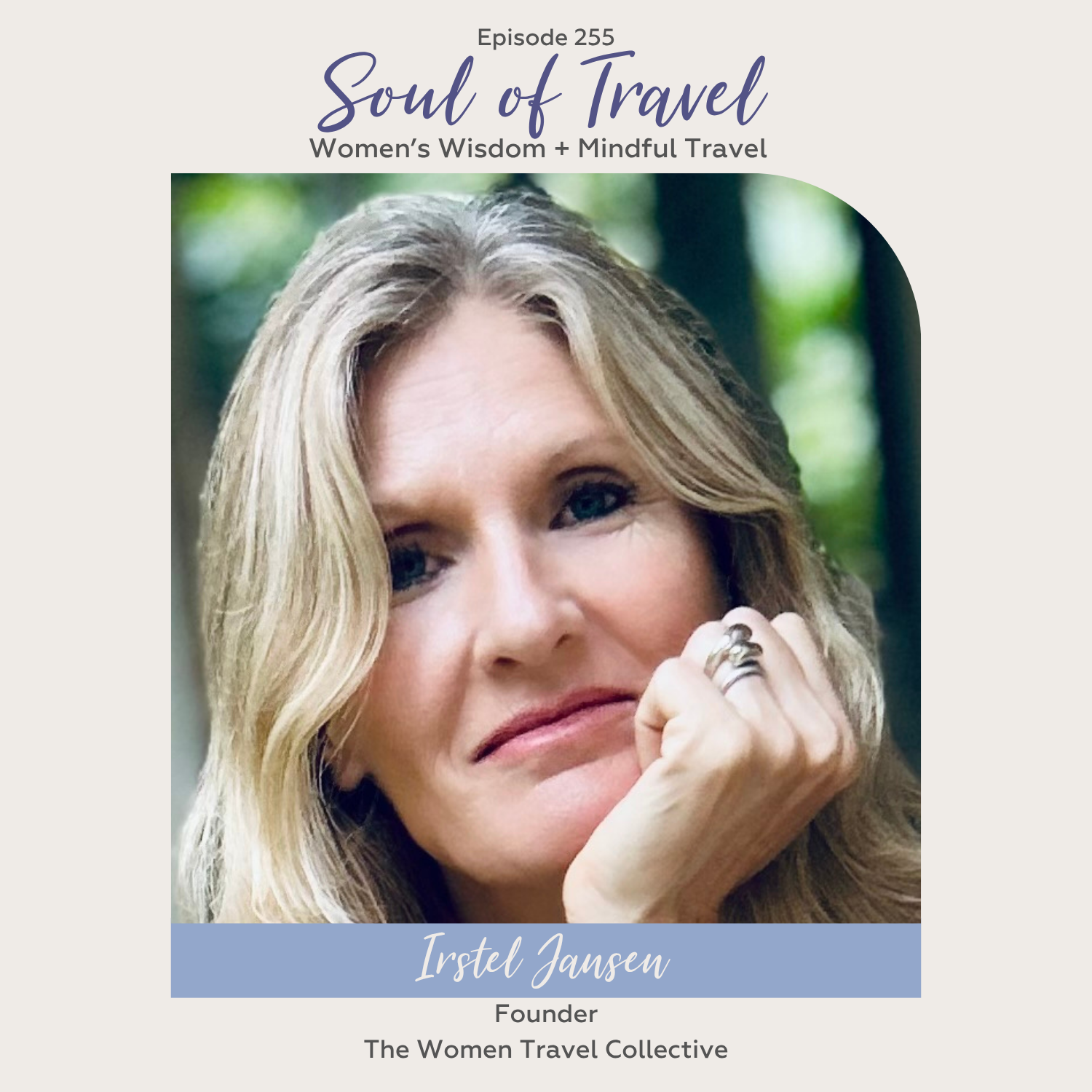
Episode 255 - Irstel Jansen, Women In Travel Collective
In this episode of Soul of Travel, Season 7: Women's Wisdom + Mindful Travel, Christine shares a soulful conversation with Irstel Jansen.
Words of Wisdom
“It's not so much about only creating this experience for travelers, but it's how we engage with them and how we pay respect and have dignity.”
- Irstel Jansen
Irstel Jansen is a social entrepreneur and a consultant in human rights in the tourism sector in Sri Lanka and collaborates with international and non governmental organizations, the private sector and public sector institutions on human rights policies, including child protection & child trafficking, gender equality and diversity and social cohesion through peace building initiatives.
Irstel is the founder of the Women In Travel Collective, a supportive community that advocates for gender equity in tourism while creating tangible opportunities for women across the industry in Sri Lanka. She has over 20 years of working experience in the field of international development, international human rights and sustainable tourism. She is a public speaker on women empowerment & gender equality in the tourism sector in Sri Lanka and is an associate of Equality in Tourism, a non-profit organisation based in the UK transforming the lives of women by advocating for gender equality across the global tourism industry.
In 2000, Irstel and her husband, who were living and working in Spain, decided to travel to Australia, moving through India, Pakistan, Iran, and across Asia. They arrived in Singapore without money, and Irstel found work with a consultancy firm focused on regional conflicts; that work brought her to Sri Lanka and to finding her way toward building and advocating for women in Sri Lanka and beyond.
Irstel’s first assignment took her to Mannar, a remote and isolated town in the north, where a civil war had displaced communities and left minefields across the landscape. She stayed with a local family and spent two days facilitating a peace-building workshop, contrasting drastically with the corporate world. She decided to continue on this new path.
Building What Was Missing with The Women in Travel Collective
In Sri Lanka's formal tourism sector, fewer than 10% of workers are women. Globally, that figure sits above 50%. The gap is certainly not due to a talent gap, but instead, a structural one that Irstel discusses in depth.
Working in hospitality carries a social stigma, particularly for women, who face assumptions about the industry's association with entertainment and nightlife in Sri Lanka. Transport is also a real barrier, and until very recently, Sri Lankan law prohibited women from working past 6pm without special employer clearance.
"There is not a lack of ambition," Irstel says. "There's a lot of women that are very, very capable. But it's just that they're being held back by these social norms that are so strong."
The Women in Travel Collective exists to be a safe space where women in the industry can share their stories, find community, and navigate shared challenges without having to do it alone. The Collective is also a platform for advocacy and building pathways for creating real economic opportunity.
One of the Women in Travel Collective's most tangible initiatives is a female guide training program developed in collaboration with the Pico Trail organization, with sponsorship from Steps Travel in the UK. The Pico Trail is a long-distance hiking trail through Sri Lanka's Central Highlands, and the women being trained to guide it come largely from traditional Tamil communities where the standard daily wage, earned plucking tea in the tea estates, amounts to roughly four or five US dollars. Becoming a trail guide can change that math dramatically. A two-hour hike can earn twenty times a daily tea-estate wage.
"Suddenly these women have that status," she reflects. "On the one hand, they are a role model to others. But it can also dangerously shift the dynamics in the community." When women gain economic power in communities where they have never held it, the ripple effects extend in every direction — through marriages, family structures, male relationships, community hierarchies.
Male allies have proven essential. A local partner in Hatton manages the women's scheduling and referrals in a way that is transparent, respectful, and trusted by the guides themselves. "When you pioneering something new, when you doing something, provoking a change, you will always get a backlash," Irstel says. The first cohort is working, as employment and income rates are growing with experience.
Child Protection and Anti-Trafficking in the Tourism and Travel Industry
Through her consultancy and her collaboration with international organizations including the UN's International Organization for Migration, Irstel has worked at every level of the sector — corporate hotel training, government policy, grassroots community engagement — on child protection and the prevention of child trafficking linked to travel.
Irstel came to this work through Thailand, where she witnessed firsthand the exploitation of children and women tied to the tourism industry. When she returned to Sri Lanka after COVID, with the country's economic crisis intensifying and child abuse rates rising, she redirected her consultancy toward these issues: educating hotels and smaller operators on identifying, reporting, and responding to child abuse; working with the government on policy mechanisms to safeguard children; and delivering trafficking-specific training to chauffeur guides and service providers across the country.
"If we don't have a healthy foundation," she says, "then people won't come and women won't feel safe and children won't be safe."
The Humanity Behind the Experience
Likewise, good intentions while traveling are not enough to uplift communities and make lasting change. While travelers increasingly seek immersive experiences: visits to local communities, interactions with artisans and guides, glimpses of life beyond the resort, Irstel discusses how it can easily become extractive. She has seen travelers photographing children in school uniforms for Instagram feeds, and treating guides as props in a story rather than people with their own dignity and complexity. She recounts a guide who, after days of leading a group through the country, was handed a broken iPhone as a tip. "They felt they wanna maybe do good," she says, "but there is that power imbalance that is playing out. It's not so much about only creating this experience for travelers, but it's how we engage with them and how we pay respect and have dignity."
The Future of Tourism in Sri Lanka
Irstel is clear-eyed about where Sri Lanka stands, as the country is still emerging from a severe economic crisis and geopolitical instability continues to affect tourism flows.
And yet she is hopeful — carefully, practically hopeful. A younger generation of Sri Lankan women is more assertive, more visible, and more willing to claim space. Members of the diaspora are beginning to return, bringing both increased education and a commitment to entrepreneurship and community growth. Irstel’s vision for what sustainable tourism in Sri Lanka could look like is based on human connection, honest engagement, investment in communities, and protection of the most vulnerable. She hopes Sri Lanka will not repeat the mistakes of destinations like Bali, and instead that it will develop consciously, keeping the country's identity intact while ensuring the benefits of tourism reach the people who make it possible.
Soul of Travel Episode 255 At a Glance
In this conversation, Christine and Irstel discuss:
· Expanding gender equity in the outdoors and creating systemic change in tourism
· The concept of rematriation and how a single word reframes indigenous women's power and relational responsibilities
· The Porter Voice Collective's mission and the Himalayan Women Trail Leaders initiative in Nepal
· Intergenerational thinking as a source of hope for the future of equitable outdoor leadership
Join Christine and Irstel Jansen now for this soulful conversation.
LOVE these soulful conversations? We rely on listener support to produce our podcast! Make a difference by making a donation on PayPal.
Related UN Sustainable Development Goals
Sustainable Development Goal #5: Achieve gender equality and empower all women and girls.
Sustainable Development Goal #10: Reduce inequality within and among countries.
Sustainable Development Goal #11 Make cities and human settlements inclusive, safe, resilient and sustainable.
Sustainable Development Goal #16: Promote peaceful and inclusive societies for sustainable development, provide access to justice for all and build effective, accountable and inclusive institutions at all levels.
Resources & Links Mentioned in the Episode
Visit The Women Travel Collective for more information about building a supportive community for women in Sri Lanka’s travel, tourism, and hospitality sector.
Special thanks to Strictly Jane Austen Tours for your partnership in the production of our Trailblazer Series!
About the Soul Of Travel Podcast
Soul of Travel honors the passion and dedication of people making a positive impact in the tourism industry. In each episode, you’ll hear the stories of women who are industry professionals, seasoned travelers, and community leaders. Our expert guests represent social impact organizations, adventure-based community organizations, travel photography and videography, and entrepreneurs who know that travel is an opportunity for personal awareness and a vehicle for global change.
Join us to become a more educated and intentional traveler as you learn about new destinations, sustainable and regenerative travel, and community-based tourism. Industry professionals and those curious about a career in travel will also find value and purpose in our conversations.
We are thought leaders, action-takers, and heart-centered change-makers who inspire and create community. Join host Christine Winebrenner Irick for these soulful conversations with our global community of travelers exploring the heart, the mind, and the globe.
Subscribe & Review on Apple Podcasts
Are you a Soul of Travel subscriber? Click here to subscribe to Apple Podcasts, so you don’t miss the latest episodes!
Listener reviews help expand our reach and help us rise up the ranks! Rate and review your favorite episodes on Apple Podcasts or your preferred podcast app.
Credits. Christine Winebrenner Irick (Host, creator, editor). GUEST NAME (Guest). Original music by Clark Adams. Editing, production, and content writing by Carly Oduardo.
Learn more about Lotus Sojourns
Looking for ways to be a part of the community? Learn more here!
Find Lotus Sojourns on Facebook, or join the Lotus Sojourns Collective, our FB community for like-hearted women.
Follow us on Instagram:@souloftravelpodcast and @she.sojourns
Soul of Travel Episode 255 Transcript
Women’s travel, transformational travel, sustainable travel, women leaders in travel, social entrepreneurship
Christine: Welcome back to our Trailblazer Series, created with the support of Strictly Jane Austen Tours. This series recognizes women who are working to bring more women into tourism and outdoor spaces from the trail to the C-suite, women leading the way in amplifying the voices of women, local communities, and underrepresented voices throughout the industry.
These women are a great inspiration to me, and I look forward to sharing their stories with you. Today, I am speaking with Urstel Janssen, a social entrepreneur and consultant in human rights in the tourism sector in Sri Lanka. She collaborates with international and non-governmental organizations, the private sector, and public sector institutions on human rights policies such as child protection and child trafficking, gender equality, and diversity and social cohesion through peace-building initiatives.
She has over twenty years of working experience in the field of international development, international human rights, and sustainable tourism. Since twenty twenty, she is a director of Sustainable Sri Lanka, a reputed consultancy firm assisting businesses and organizations in the Sri Lankan tourism industry to comply with international sustainability standards.
She is a public speaker on women's empowerment and gender equity in the tourism sector in Sri Lanka and is an associate of Equity in Tourism, a nonprofit organization based in the UK transforming the lives of women by advocating for gender equality across the global tourism industry. Urstel is the founder of Women in Travel Collective, a supportive community that advocates for gender equity in tourism while creating tangible opportunities for women across the industry in Sri Lanka.
Urstel holds a master's degree in international law and human rights from the University of Amsterdam. In our conversation, Urstel and I discuss how her work beautifully weaves together advocacy, ethical tourism, creativity, and community empowerment. She shares how her path led to advocating for gender equity in tourism and creating pathways and opportunities for women in Sri Lanka.
She also discusses her work protecting children and women from trafficking linked to travel and tourism, and she shares her thoughts on the role she believes community, storytelling, and leadership from women will play in shaping the future. Thank you to our Trailblazer Series sponsor, Strictly Jane Austen Tours, for supporting conversations that inspire deeper connection through travel and celebrating trailblazers shaping a more thoughtful and inclusive industry.
Join me now for my soulful conversation with Urstel Janssen. Welcome to Soul of Travel podcast. I am your host, Christine, and I am very excited to be bringing you the next episode in our Trailblazer series. Um, these have been really special conversations, and I'm just delighted to continue to bring these voices to this space as we begin season seven.
Um, today I am very, very happy to be joined by Estelle Jensen, who is, um, she has so many hats, actually, I'm not gonna name all of them in this moment 'cause we're gonna go into each of them, and I'm gonna let you introduce yourself. But I just wanted to start by letting my listeners know that much like many of my guests, you are kind of one of those people I've been following online for such a long time.
Um, I went back into LinkedIn and I- it's at least been several years. And why it was important to me to have you join this conversation, um, is because I am just so inspired by the work that you're doing in Sri Lanka and also, um, everything that you're creating collaboratively there as a community and as a collective, which we're gonna talk a lot about.
But, um, I just have been continually inspired, and we've talked as we were preparing for this conversation, like, um, proud of what you're doing just because of this synergy of creating spaces for women that are really transforming what indus- this industry looks like, what the status quo is, the opportunities you're creating.
And so I just am really honored to have you here and, um, and, and very happy to welcome you to the podcast. So thank you for joining
Irstel: thank you so much, Christine, for having me. I mean, it's, it's an honor myself and, um, I'm quite, um, yeah, a bit, um, taken back with everything what you said. I, I think what, um, what we're doing is it comes from the heart, from, from what I always loved doing. And, um, I, I guess from the very beginning, um, I've always been somebody quite, um, uh, idealistic.
So, um, I'm really excited to talk to you about the work that I do in, in Sri Lanka. So thank you so much for having me, uh, on your podcast.
Christine: Yeah. Thank you. And I wanna give a quick shout-out to Dee Gibson, who was actually the person that initially, uh, made the connection. She had told me about you in her episode, which I think is what led me down the path of following and discovering your work, and she, I know, is a, a great, um, is a, an important part of the work that you're doing as well.
So I just wanna make sure we mention her, and, um, we'll tag her episodes also in the show notes. People can go back and listen to Dee because she's one of our, our favorites here on the podcast as well. Um, to begin the conversation, because this is our trailblazer series, I just wanted to share why, I, I kind of mentioned, but why I wanted you to be a part.
And, um, I, I really enjoy the kind of trailblazing way that you've been creating pathways for future generations by really reimagining tourism as a force for gender equity, including child protection and community empowerment and ethical leadership, which is really opening doors for women and shaping a more just and inclusive industry in Sri Lanka.
So that is the, the trails I see you blazing, and I'm so excited to talk more about this. Um, I'd love to just give you a moment to introduce yourself and tell us a little bit more about the work that you're doing with the, um, Sustainable Sri Lanka Women Travel Collective and, and all of the work that you're doing together.
Irstel: Um, well, my name is, um, Irstel Jansen. I'm Dutch, and, uh, I'm, I'm based in Sri Lanka. I live here with my family since, um, 2003. Um, and yeah, I mean, Sri Lanka has become our home. That's where our kids grew up. I'm a mom of three boys. Um, and yeah, professionally, I, um, I'm a social entrepreneur. Um, I work as a human rights, uh, consultant in the travel and tourism sector in Sri Lanka.
And, uh, as you mentioned, I, I'm mainly focused on, on, on child protection and, and advancement of, of, of women's rights, uh, in this sector. Um, and, um, yeah, I'm also the founder of the Women in Travel Collective. Um, I think together with what you, you just mentioned, Dee Gibson, um, my other colleagues, co-founders, uh, Dinushka Chandrasena, Andrea Gunasekara, and Thushani de Silva, we, we felt very strongly that we needed to do something about, um, m- about more women rep- uh, representation in the industry.
And so we wanted to create a space for women, um, uh, a supportive community for women in the, in the sector. And, um, at the same time, the Women in Travel Collective is also a platform for advocacy for, for more female participation. But as you probably have seen, uh, through our work, through our projects and programs, we really also about creating more opportunities, uh, for women.
And, um, yeah, I can tell you more about that, uh, that later, but, um, this is something that I am really passionate about. I think especially, um, community nowadays makes so much sense in the world that we're living. And, um, we, we hear from women in the industry is that there are so many capable women in the industry, but they're all navigating their, their challenges and their, um...
because of cultural stigma here in Sri Lanka in, in their own way, um, sometimes through hardship as well. And I think that space that we're creating, that, that human connection, what people really looking for, um, a, a safe space where people, uh, women can, can share their stories, uh, their experiences, is something that has, um, proven very valuable.
And, um, um, yeah, so that is something that, um, we keep on building and, and, and we're, we're advocating for, um, together. So, um, I'm really, uh, in many ways also very privileged, and I feel very honored that, um, that I can do this here in Sri Lanka, and I'm very grateful for Sri Lanka as well, that it has given me these opportunities to, to really also be able to make that difference here in the country.
Christine: Yeah. Thank you so much for sharing that. Um, I think where I would love to start, f- for me, the soul of travel is really about, and you kind of mentioned, you know, this part of you that has always been driven by community and by advocacy, but for me, the soul of travel is kind of like finding the catalyst of that spark, because that's the thing that carries our work forward, and I think allows us to have the biggest impact.
So I would love to hear kind of what experiences first shaped your understanding that tourism could really be this place for social impact and systems change, and also, you know, just how did you You might also share how you ended up in, in Sri Lanka, 'cause that might give us some insight into this path that's carried you
Irstel: Yeah, um, of course. Um, well, that was, uh, through my work, um, because I'm an, I've a human rights background. Uh, and came to my work to Sri Lanka in 2001, and, um, yeah, it was, um... I think as I mentioned earlier, I always had that, um, sense of carry that, um, sense of social justice, uh, with me ever since I was young and as a student.
And in 2000, um, I lived in Spain. Uh, my husband is, is Spanish. And, um, we both were working in, in, in very high demanding jobs. I was working for a consultancy firm, uh, linked to the European Union, and it was in 2000, I don't remember, but it was a change of the century, right? It was this momentum, and my husband and I were just reflecting on- Um, on our lives, and we were not really ready to s- yeah, to build up, um, and settle down and have kids.
And so we decided to, um, go on this adventure, and, um, we embarked on an overland trip from Spain all the way, uh, to S- to Australia. Um, that's where he, uh, grew up as a little boy. And, um, and I think that trip really, um, shifted something in me. It brought me to Asia. Um, we traveled extensively to a lot of different countries like India, Pakistan, Iran.
Um, and, um, we ended up in Singapore without any money, but it was there where I found, um, a job with a consultancy firm, very fortunate, that was, uh, working on conflicts in the region. And, uh, and through that, through that work, um, that brought me to Sri Lanka. Um, I, I still remember, um, our first trip that we arrived, and it was such a huge contrast with, with Singapore, the corporate environment, and, and I just remember to feel that, that energy, that connection with the country immediately when I, when I stepped out of the plane.
And we were, um, we were sent up north. Um, Sri Lanka at the time was, it was in a civil war, and we were there to provide a, an, um, peace-building pro- uh, workshop for, for two days. And Mannar is a very isolated place, um, very remote, and, um, there were a lot of displaced people because of the war and, and land disputes.
And I just, I just saw the, the physical impact that, that the war had, uh, on the community, on the children. There were minefields everywhere, so it was a very dire situation there. And we stayed with a local family. There were no hotels. There were no guest houses where we could stay. So after those two days, I just...
Yeah, it was, I think, a, a moment where I realized this is the work that I wanna do. I, I don't wanna go back to Singapore. I don't wanna go back to Europe. This is where I feel where I can make a difference. And I still remember I was sleeping on a mat on the floor because that's, that's how we, we, we, we were living with, with this family.
And then I woke up thinking in the middle of the night, it's like, "If I go back to Singapore, I wanna ask my, my boss if I could, um, stay in Sri Lanka and, and continue the work from here." And so we had some long conversations, and, uh, he finally agreed. And, um, and so yeah, so we set up an office here, and my husband joined me later.
And, um, yeah, so we never actually, uh, came back. But- Yeah, that has been really, um, for me, um, since I, I, since I was, um, working, uh, you know, in, in, in, even when I was a student studying, that was actually my dream. I always wanted to be, uh, at grassroots level making impact rather than sitting behind a computer, um, working from a certain office, you know?
So, um, for that I've been, yeah, as I said, I'm very grateful
Christine: I, I really appreciate you sharing that. And one of the things that really resonated for me was the moment that you recognized how you felt when you landed in Sri Lanka. And I think, um, that might be something people gloss over or don't pay attention to, but because I've-- I feel like I felt that similar thing, there's something really significant in that.
I'm one of those people that kind of believes the universe gets really excited when it's put you where it wants you to be, and it sends you messages so that you know, and I think you can feel that in your soul if you're paying attention. Um, and so I, I love that there was something in you that just went like, "Aha, I, I need to be noticing what's happening right now around me because it's significant."
And I just wonder for you, you know, w- how that resonates for you. Like if, if it did feel like a pretty significant awareness that you had, you know, as you landed. You said it, it felt important that you were there
Irstel: Oh yeah, immediately. I think, um, it was, it, it, there is a certain energy I feel, uh, in Sri Lanka, and it was almost kind of an, a deja vu moment that you sometimes have in places, right? And, and often people when they come to Sri Lanka, when they travel, they talk about the smiles of the people and about the beauty of the country.
But I really connected with the, with the energy, and, um, it was something that I, I just feel, I just felt home. I just felt this is, this is where, um, I can live, where I just feel myself. And, um, and that felt really special. Yeah
Christine: Yeah, I think that's such a gift, and I know many of us kind of seek that moment, so I just, I just wanted to, to lean into that a little bit. And I think it's interesting, too, um, for me on a personal note, how many times that, like, this idea of the intersection of women and social impact in Sri Lanka has come into my life, and there's been so many people I've met.
And so for me, it's one of those things where I keep saying, "Yes, I, I hear you, I see you. I'm very excited for whatever lays in the future." I still haven't been able to travel there, but I know... Like, I just feel like it's an important thread in, in my own, my own journey as well. So anyway, I just, I, I love that, um, that idea, and I, I have talked to so many people as well on the podcast that that's that thing.
Like, and, and it's usually just out of left field, right? It wasn't that you're intending to go there and you had this big plan. It's that all of a sudden your path led you there, usually without expectation, and you just sense something bigger than yourself. And so I, I really love that that is a part of this catalyst of the work that you've been doing is this place that you landed.
So, um, yeah, I, I just wanted to, to acknowledge that before we moved any further. Um, I would love to talk to you a little bit more about, um, you know, advocacy for gender equity is ob- obviously so important. Um, I would like to kinda help paint a picture for our listeners. What, what are some of the pathways and barriers that you're really, you know, finding women are up against?
And, um, what gives you hope in what you've already seen changing as you guys have been working together as a collective over the past few years?
Irstel: Um, yeah. So I, I, um, in Sri Lanka, you know, um, it's a Buddhist, um, country, and um, of course we also have a very strong, um, Tamil population. Um, but the, the tourism and travel sector, um, is, is in particular a, a sector where only like less than 10% of women working. Um, I mean, if you compare this globally, it's like I think over 50%.
So the reason why that is, is definitely because of culture norms and of social stigma that's exist around women working in, in, in the travel and tourism sector. Um, women still, uh, be seen in, in very traditional roles, right? Of taking care of the children, of their household, of their elderly. Um, it's also very much to do with safety.
Um, they don't feel safe. It's associated with a, an industry of entertainment, of, of, um... And, um, and also not only, uh, at the, at the different, uh, if you, if you would look at a particular hotel, but also, uh, the places where women work. But it's also the, the transport system which has proven to be a very, um, plays a very important role in this when women have to commute from back and forth.
It's, it's a lot of the times women get harassed, um, in the bus or on their way to, to work. And so they're really not encouraged to, um, to work. Uh, and especially in the tourism sector, uh, as I mentioned before, there's an even bigger stigma. And for a very long time, uh, in Sri Lanka as well, it was for women, um, impossible to also choose to work in an, in a restaurant or, um, till late at night because the law was discriminating.
They were, um, you could just only work till 6, 6:00 PM in the evening. And that made it also for employers very, very hard to employ women, and they needed to have special permission. Um, and it's only very recently that this is, um, now changing. Um, it's still hard, um, because it's so ingrained in, in the industry.
Um, but um, yeah, we, we just hear from women that there is not a lack of ambition. Um, or you know, there's a lot of women that are very, very capable. Um, but it's just that they're h- being held back by these social norms that are so strong. So, yeah
Christine: Yeah. Um, I, I think that's so important to just share because I think when you're looking at this from a global perspective, you know, not everyone is having a, a similar lived experience, and so we might not even understand, as you said, transportation being a huge barrier. That seems something that, you know, I might overlook in looking at problem-solving or trying to how to get more women in the industry.
And so I think it's, it's really important, um, to understand culturally the differences and the barriers that people are facing to, to even have a little bit of insight into where you're starting to... You know, the starting point to move forward. And I think I was really surprised, I actually didn't realize that the statistic of 10% was that low, specifically because women are such a huge part of the tourism industry, even if it's unpaid tourism or, you know, unpaid work in the tourism industry.
Um, they are a significant portion, so that's such a, a big gap, um, that you're looking at.
Irstel: Yeah. Yes, it's a hu- it's a huge gap. And I must say, I mean, this is, these are, these are numbers from the formal sector. There is a lot of women that do work in informal sector. So in Sri Lanka, if you would travel on the road, you will see little caddies, like little, um, places where women maybe do some crafts work.
Um, you see now over time that there's, uh, more women that, um, you know, have created their own home stays. And, um, so you s- you see a, a change, uh, happening. Um, but even then, I think if you look at, for example, an, an home stay run by women, you often see still them doing the traditional roles of making the beds, um, doing the cooking.
Um, so yes, it has an entrepreneurial side, but often again, there's the... It's very male dominated. It's still the, the man is there to kind of get control. Um, and so, um, in a way, um, there is, uh, in the formal sector, I think there is more representation of women. But in the formal sector, not, not, not as yet.
And I think that is what we are really trying to, to make a little contribution to, to, to create awareness and, um, um, by, by what we do through the Women in Travel Collective.
Christine: Yeah. Thank you for sharing that. I think it's also interesting when you look at, you know, what is, um, adjacent to the travel industry and as you were saying, the traditional roles of women in, you know, housekeeping and food preparation, but also in ar- artists and goods and crafts and in maybe even in wellness.
And, you know, if you're looking at travel, a lot of times you'll be adding in, like, yoga or meditation or, um, for me, like arts and crafts or artistry, and all of those things also tend to be places where women gravitate towards naturally and tend to be low paid or underpaid. So it's like you're, you're not only, like, trying to get more women involved, but you're having to break down all these stigmas around the value and the worth of those activities, which I think can be interesting, and not just in Sri Lanka, but this is, you know, as a whole, placing a value on some of those things is very challenging.
So I think that keeps us in this weird place of, like, knowing our worth, asserting our value, and then also having people that go before you that kind of set the boundary, like charging for what they're doing, raising prices, showing that that is worthwhile. I wonder how in your working with women in the communities, like, how do you, how do you kind of navigate that or coach them through knowing what they're doing has value, has monetary value, but has value?
Irstel: Um, that's a very challenging question. Um, and, um We've, we've had this, like, uh, for example, with the female guide training program, um, that, uh, I think you, you know of and you've been following. Um, it's an program that we, um, we were very, um, yeah, grateful for Steps Travel in the UK to sponsor this. And this was an, uh, an, an initiative that we did in collaboration also with the Pico Trail Organization.
So it was about training women along, um, the Pico Trail, which is a long distance hiking trail through the Central Highlands of Sri Lanka. And these women came from or come from very traditional, um, Tamil backgrounds. And, um, and what I always, um, find so important is when we train them to become guides, um, and give them that skill set, um, as you were saying, um, you've given them the skills, now what?
Because now they're going to enter into a very do- male dominated, um, sector, and how do they keep stand and how, uh, can they monetize on this? Um, you have to ima- even imagine that their women or their, their, um, even their, um, aunties and, and, and, and grand- mothers, they, they were plucking tea in the tea states.
And to give you an example, I mean, an daily wage would be 1,700, 1,800 rupees, which is maybe about four or five, uh, dollars a day. And suddenly these women that entered, uh, this, this industry where they take travelers on the trail, um, and they could just charge, um, like 20 times as much, uh, just because of a two-hour, hour hike.
So that is... has been for us also a change in... uh, sorry, a challenge in how do we make sure that, um, that shift that they will bring into the communities, because suddenly they, they have that status, right? They also, on the one hand, they are a role model to others, but it can also dangerously swift- shift the, the, the dynamics in the, in the community.
So we do touch on that. And, um, Tushni, my colleague, um, who is the, was a trainer on the, with the, on the female guide, uh, training program, she always mentioned, be humble, right? Remember where you're coming from. And, um, together, like, looking at the industry standards, if you look for example, in this particular case about the female guides, we were looking at, okay, what, what is the norm?
What do the, let's say the, the more- seasoned, uh, guides, um, being paid. And what we recommended to do was to start off with an, with a very low, reasonable, um, affordable rate for travelers. And while they were gaining more experience on the trail, getting more exposure, shadowing other more, uh, experienced, uh, guides, then they will slowly will, will increase, uh, their rates.
And, um, and that is something that we've, we've tried, um, to manage. And, um, I must say that with our cohort in Hatton, um, that is being, um, quite successfully done also because we have somebody there, a local, um, partner who is an incredible man, who has been so supportive of this group of women, and has almost taken them under his wing.
And in a very transparent way, have set up a network where they get each their turn. They... He's managing them in a very, um, I would say, yeah, transparent and respectful way, and they really trust him. Um, they love to work with him and, uh, and that, that has been very crucial for us as well, yeah, to have s- to have male supporters in this, yeah
Christine: Yeah, I, I agree. I think that that quickly becomes something that communities of women and people working in advocacy for women in travel have found that you do need to have male allies and support because the barriers still exist, so you have to have partners in, you know, dismantling that and, and that's where the power dynamic, that's where you need to go, right?
Um, I also love the awareness of, uh, you know, the... Again, like if you're just thinking, "Okay, my goal is to get more women employed, paid fairly, equally," and, you know, you're checking off these boxes, and then you realize now you have these women who have that they've never had before in their communities.
Um, then you're looking at the, the complexity of that typically means the person with that wage has the power, and now you have women with power that haven't had power before, and you have whole communities reacting to that. So it's, it's... I, I just think it's, um, to me, seeing this happen here and in other communities, how you, how you have to take in all of these parts and pieces, and sometimes you don't, you don't discover it until you land there, right?
You- maybe you didn't anticipate the outcome, but now you have another challenge that you have to navigate, and I think even for some women, that, that can be a really high, you know, like a h- heavy cross to bear. Like, you want to achieve all these things, but all of a sudden, are you ready to step into this role or to navigate this other challenge?
And so I, I think it's really important, like you said, that with the female guide training program, that you're having these conversations, you know, getting to know what does that really look like and feel like where, y- you know, where you are living and how is that impacting power dynamics. When these roles shift, do you know how to handle that within your own life, within your own self?
Because that's big changes and, um, I think that that can be overwhelming and, and maybe even a part of the problem, like part of the barrier is that even if we don't wanna be here, it feels safe because you know it, and these other challenges are unknown. And so again, there's a, a lot of personal growth that has to happen with this kind of cultural disruption.
Irstel: Yeah, absolutely. And I think also, um, community comes in here again. Um, and th- that's what we see. Um, there's such a need to, to create a supportive network community. So what I see a lot here in Sri Lanka when I, when I work, is that there's a lot of even aid organizations, they come in with good intentions, or travelers come in with good intentions that they wanna help in communities or make donations.
But often what happens, these are short interventions and, um, sometimes they are not even met. People are going back, um, with aid organizations, the money run out, project are like halfway done and, and often then the consequences is that more harm is done than good. And, and so I think that living here in Sri Lanka, um, and being available, um...
By that I mean to give, to give these women, um, that support. I mean, they, they, they will reach out to me. Um, and, and I think that creates that connection. Um, and at the moment we are also talking, um, collectively with- within the women co- uh, collective, our team, is how we can keep on providing support for them.
Is it... Because as, as what you said, you, you give them the skills, you give them the training, but then what? Because they facing still a lot of challenges, and those, those challenges don't go away overnight, and it's a process. So that, that's, that's... That community, that safety net, that, they, that's what they will need on the long term for, for a while, until they find that balance within the, in community, um, themselves.
Um, and, um, and not only them, but also the males. The, the, the, the... They also had to adjust, right? To suddenly see female guides on the Pico Trail, for example, and how do they go about this? And I can share with you, when we, when we started the female guide training program, we got a lot of backlashing. "Yeah, but you can't call them guides because they're not officially, um, going through the national, uh, regulations."
And, uh, and so these are little things that we were encountering in the beginning. Um, these are things that happen, right? When you pioneering something new, when you doing something, provoking a change, you will always get a backlash. You will always people that are trying to hinder you. And in this case, it was unfortunately some of the...
Not all, because there's a lot of, um, male support as well. But there will always be people that were making it a little bit hard, you know, when you're trying to, to, to provoke a change, um, with a, with a positive outcome, of course. Yeah.
Christine: Mm-hmm. Yeah. Um, well thank you for sharing that. Um, as you mentioned i- in your introduction, um, I really wanted to take a little bit of time to talk about, um, child protection and tourism because we haven't had an expert in this on the podcast before, and that was another thing that I was very interested to learn about, was a part of your background.
Um, I think this is a- again, something that, um, is globally significant but probably regionally the im- the, the, um, challenges, you know, really vary and on a whole is something that I feel like isn't talked about. And I would really love for you to share more about what you're doing and then how the industry can support advocacy and policy that really works to protect, um, children and consider trafficking and its interconnectionness with the tourism industry
Irstel: Yeah. Um, yeah, sure. I mean For me, um, I think through my work in the industry and, and it was going back, uh, many years when my husband and I set up Sri Lanka In Style, our travel company. Um, it was I think much, um, later in the journey when, when we were, um, finding our path within the ind- the Sri Lankan tourism sector.
And at the height of the war at the time, we, we went for two years to, um, work in Thailand. Um, we couldn't really continue here. Um, and, uh, and I think it was in Thailand, um, where I saw the negative social impacts that it had on, especially on the exploitation of t- of children and women there. And so that was, that was a shift for me.
Um, it brought me ba- ba- bit more back to my human rights work. And, and so when we came back to Sri Lanka, um, I felt that was really, like, what was going to give meaning to my work. Because to be really honest with you, when we were setting up the company, I thought the entrepreneur side was, was interesting and challenging, but I was missing purpose.
And, and I think, um, when, um, during COVID, when everything was slowing down and I had a chance again to re-educate myself and specialize in, in, in child protection and children's rights, um, that's where, um, I... After COVID, I, I then, um, through our consultancy that we had set up, I started to, um, engage with the industry at a different level.
So I, um, I realized that, um, you know, as I said before, the in- the industry, when we promote Sri Lanka, um, you know, we're talking about the beaches, the... Everything is, is, um, is beautiful, right? We just wanna sell the destination. But on the... That's all on the surface, but when we're looking under the surface, there is a lot of, uh, challenges that are at play.
And, and one of the, the, the things that c- became very apparent after the COVID especially was child abuse. It was on the rise because obviously because of the financials, the economic situation in the country, um, children who are a lot of time were at home. Um, there is a lot, unfortunately, of domestic abuse.
Um, and so to raise that awareness in the industry by going to different stakeholders, like hotels, uh, smaller SMEs, and talking about the importance of identifying child abuse, um, in an hotel, for example, um- How, how do you identify a case and what do you do about it? How do you report it? And that was something quite unspoken of, right?
If we would approach an, an hotel, there was something that, um, I think, um, yeah, it was a sort of a taboo. But because there was so much talk about sustainability during the COVID times, and I'm not sure if you remember, but I think a lot of people talked about the environment, uh, impact of our travels. But it was not a lot of focus on the social side of things, on the negative social impact that travel can have.
And through our consultancy, um, we started working with an organization called Travel Life, and we were assisting different hotels and, and smaller SMEs with complying to international sustainability standards. And a big part of that was also human rights, and child protection was a, uh, was a, was a key part of that as well.
So over time, I, I, yeah, I educated, I, I, I exposed myself to webinars and, and started to give training, um, and more and more on the focus on, on child trafficking because we got, um, through, um, you know, the government, there were some statistics there that it was on the rise. And, um, and so I worked with international organizations.
I also worked with the government on, um, how we can create mechanisms to safeguard children in the industry, so that is more on the policy making side. Um, but also I worked with the United Nations, um, uh, IOM on, uh, a training that, uh, we specifically did, uh, around child trafficking to chauffeur guys with different service providers around the country.
So what I do is I work at different levels and different layers of the industry. At this, at, at the grassroots level, at the communities, but also with the government and, and the industry stakeholders itself, whether it's that training on a more corporate level. Um, but of course, my passion always has been with, with the communities and, um, and that's where, um, yeah, most of the time I, I engage with
Christine: Yeah. Um, thank you for walking us through that. And I think, um, just noticing, you know, with many of the things we've talked about today is the, y- you know, where you were saying was taboo topics, things we don't talk about, and, uh, things that aren't being addressed by the industry because it's makes people uncomfortable, or, you know, there's, um...
Yeah, just the taboo associated with it and how, um, how important it is to get past the, the discomfort that you feel in having the conversations in order to enable the change that needs to come, and I feel like that's probably, you know, similar across all of the work that you're doing. You know, the ability to be a little bit more forward-thinking and the ability to walk people through those conversations I think is a, a unique skill.
A lot of people can't do that. They just... It's not... That's why these things continue for as long as they, as they do. And so I just wanted to thank you for, for stepping in there and educating yourself and then advocating for others in a, in an area that people are uncomfortable working in, and also just to kind of recognize some of the changes in the industry, um, across the board.
Like traveling with my daughters, I always point out the signs that say, you know, "If you witness trafficking," you know, or, "Here's three things you might look for," or who's, "Here's who to call. Here's the numbers." Um, because it's usually up in the women's bathroom. That's where I see it. I don't know if it's in the men's bathroom or not, but um, and for me, you know, one, it's for awareness for them to realize that this is a part of the culture of, of travel and a part of, uh, you know, an issue in the world, but also for them to be an advocate and for them to be comfortable and aware of the topic.
So I think that, that those things are all important pieces in kind of solving this problem, is you, you have to have more people a part of the conversation, and you have to allow people to navigate that discomfort and become a part of it.
Irstel: Yes, yes. And it's, it's... I think it's engaging with, with people. Um, what I find so interesting over the years is that, um, it is, it is, um, a ch- uh, an, a challenge, especially of course, when you talk about topics like, um, child protection, child abuse, um, gender equality. Um, you, you imagine that when, um, you are giving a training, you sit in front of a, of an audience which are mostly men.
So just even starting the conversation, some of them would just not look you in the eyes. They maybe look you away because you are a woman. Um, and so even that is, is a challenge in itself, just delivering of, of the training. Um, so even there, it's, it has taken me a lot of time to, um, yeah, to break the ice.
And so what I f- often do, um, during a training is that I refer to my own children, that I'm a mother, that I live here in Sri Lanka, and, um, and that is often give me a bit of that credibility. And then, you know, we then go into the conversation much, much easier, more, m- much more accepting of the fact that, you know, I live here.
And, um, so that in itself also over time was, was for me a, a challenge, I must say, to, to work as a woman also in the industry, um, because it's so male-dominated and such a taboo of an, a topic
Christine: Mm-hmm. Yeah. Yeah, I can imagine, uh, especially where you are and, you know, being a foreigner as well, like you said, you really have to establish that credibility 'cause there might be additional resistance that you might not actually understand what's happening or, um, be allowed to be a part of kind of this, uh, I guess, domestic conversation, right?
That's within the country. There's a lot of sometimes, um, not gatekeeping, but you know, like they don't want someone from the outside to see your secrets, I guess.
Irstel: Yeah. Yes. Yeah
Christine: Um, well for you, I, I'm wondering too, when you're looking at, you know, all of the work you've done in community initiatives and policy and advocacy, how do you really stay connected to the human stories? 'Cause I think that's essen- is essential while you're navigating these larger system level change.
Like, how do you bring those two pieces together?
Irstel: Um, yeah, that's I think a very important question. Um, and, uh, it's, it's a, it's a thing that I've been talking... Not, not talking a lot, but in myself talking a lot about how important it is. Um, because what we see, and you, you might just probably also from your, from talking to other guests on your podcast, but there is such a, um, rise in, in, in community-based tourism.
There's travelers that wanna experience, right? They wanna go into the communities. They wanna interact with, with, um, um... Whether it's the crafts, uh, or if it's visiting a school, or you wanna do a, a mask workshop. Um, there is a lot of, um, um, let's say, um, almost a hype around, um, women... Uh, sorry, about, um, travelers coming to, to communities.
And, um, what, what I find, um, interesting is that- A lot of, of the time what I see when people come is that it's more about consuming that travel experience. So it's behind the children, behind that inspiring story, there is a human being, right? And so it's almost as if we're reducing these people by the way we experience, um, or the experiential way of traveling that is so much promoted now.
And I mean, I can give you example when, when, when also on the Pico Trail or when you go to the communities, often you cross with children and they, um, you want... They, they look beautifully, sometimes in their school uniforms, and they wanna take pictures and, um, and so they become almost objects, right? It's, like, beautiful for an Instagram, uh, feed and, um, but what you, what you have to realize, they are children.
They're children that go to school, that have a life, that have rights. And, um, the same thing applies to, um, the guides that we're talking about, and n- not necessarily only the female guides. But recently I heard a story of, of somebody saying that, you know, th- a, a group of travelers had been traveling with him through the country, and when they were saying goodbye, they had given him a broken iPhone, and he felt very humiliated.
And, and they, I think th- that, that humanity, right? It's, it's, they feel they wanna, they wanna maybe do good, but there is that, that power imbalance that is playing out. And, and I think that is, that is something that we need to talk about much more in the industry because it's not so much about only creating this experience for travelers, but it's how we engage with them and how we pay respect and have dignity.
Um, if you, if you know what I mean. So that is something that I find so important that we striking the right balance and that we talking about this within, within the industry, uh, much more because that is, is so crucial. Um, yeah.
Christine: Yeah. No, I, I think as you were speaking, it kind of reminds me of early in my career when voluntourism and volunteer tourism was such a, you know, a, a buzzword, but it was also something that people really wanted to participate in with the best of intentions. And then as you got further down, you know, the road with that, then you would see where, where the gaps were, where, where when you are just creating the experience underneath that umbrella, you're not actually looking at the bigger picture.
The same with community-based tourism, like just because you're traveling and immersing yourself in a community, it doesn't make it inherently better travel. It just has different challenges. And so I think we have to be so conscious of, uh, uh, I mean, kind of all the trends, responsible travel, sustainable travel, all of the things.
Like they start out from this place, I think, of good intentions and probably good actions, but when you try to mass produce that experience, somehow you lose that connection. Like we were saying, that connection to people is really important, and so you can't... It, it, it becomes imbalanced somewhere along the way, and I think we just as an industry need to be really aware that, as you've said, that's the most important part.
Like, I, I think for me, that's really where my work started because I know- would notice that imbalance, and I didn't wanna be in that situation. And then I realized, you know, that whoever I was traveling with or whatever experience I was participating put me in that position. So then I was like, "Oh, okay, so this isn't just necessarily about here.
It's a, a broader industry, um, problem that, you know, we just, we need to examine where that shift is happening from like good intention to unaligned action that happens." And so, yeah, I, I think that's really important. I think it's really challenging, um, because even as communities then start to participate in tourism and, and receive the economic benefit, then they want more tourism, and so it's even easier to, kind of accelerate that imbalance and that inequity and that extractive component of tourism.
Irstel: absolutely. Yeah. Yeah
Christine: Yeah. Um, well, as we end our conversation, I would love to talk to you just a little bit about what you think the future of tourism in Sri Lanka and globally might look like, and the role that community and storytelling and leadership from women will really play in shaping that
Irstel: Um, well, yeah. No, it's... That is going to be, I think, um, a must, uh, if we talk about more female participation in industry in Sri Lanka. I mean, even if you look at it from an, let's say, more macro level, more, um, economic point of view, um, we've had experienced so many people leaving the country because of the economic crisis that we've had.
And so it's almost a no-brainer that moving forward, that we need to, um, tap into that other half of the population which is so talented. There's so many, as I said earlier on, there's so many talented women, educated women, and I hope that, um, that shift is going to, to take place over time. Um, there is still an, an older generation, but I think what I see the next generation of, of women, um, in general actually, the ne- the next generation, they're much more about speaking up.
And, um, and I think in Sri Lanka particularly, through social media and, and we, we seen that little shift happening that people are a bit more assertive. And, uh, th- we also see a lot of, um, the diaspora that left, um, you know, Sri Lanka during the civil war and, and now going back. Um, educated people that wanna come back here, build up their lives, wanna connect with their roots, and, and set up businesses, what is, what is already happening, uh, to an extent.
Um, so I would say, you know, tha- that is all, I think, very promising. Um, what is important for Sri Lanka itself is that there is stability, there is economic stability. Um, we're still coming out of this economic crisis from a few years ago. Now, of course, we have the war in Iran happening, so again, that had a huge impact on the, on the travel and tourism sector, um, unfortunately.
But, um, I think that what you, what we talked about just earlier about that human connection, I think that is going to be so important. I mean, um, we are social beings, we are social creatures, and I think travel is, is going to be... is, is bringing that, c- connecting people. Um, and, um, and I think if in Sri Lanka we're doing that in an, in an, uh, in a conscious, in a responsible way, what I, what we were just talking about, the way we engage with people, I think that will be, on the long run, a very sustainable process.
Uh, while keeping in mind also, um- That of course Sri Lanka in many ways it's, we're still developing, but there are so many lessons that we can take from other countries. And, uh, when it's, whether it's destination development and, um, uh, building of, of, uh, resorts. Um, you know, we, we still have more or less an unspoiled country.
And I think, um, be- I especially hope that, you know, we don't fall in the same, uh, trap as, for example, a country like Bali. Um, and that we are conscious about how we are going to, um, promote Sri Lanka, um, as a destination. Um, and, um, and, and in that, in that context as well, I think what is, in very important, um, is, is, is, is that we take responsibility about, you know, things like child trafficking and, and exploitation, um, of women and, um, and that we keep that in mind because we can promote Sri Lanka, um, you know, to the moon.
But if we don't have a healthy foundation then people won't come and women won't feel safe and children won't be safe. So I think that is, um, that is, I think is very important when we, when we move forward, um, in the future
Christine: Yeah. Thank you so much. Um, now I wish we had so much more time to, to talk even more about that and the development of a destination from the point that you're at right now. But, um, luckily for our listeners, we, we are gonna have a- another conversation, um, with, you mentioned your colleague Thushni De Silva, and we're gonna talk later on a little bit more and then, um, bring some of the women of y- in your collective together to have a, a group conversation.
So I'm really excited about that, that this isn't a stopping point, thank goodness, 'cause there's so much more to explore. Um, before we end, I have a series of rapid-fire questions or rapid-fire-ish that are just a little bit, um, a little more fun, but just to get to know you more as a traveler and as a person.
Um, the first question is, what are you reading right now?
Irstel: Um, oh, I, I read, uh, a lot of different books at the same time. So I have a book, um, which is The New Earth by Eckhart Tolle that I'm reading on and off. Um, The God of Small Things. Um, and, um, I'm also reading an, a Dutch book on, um... No, and I read, uh, I'm, um, um, g- went back to Timothy Snyder on freedom. Uh, and I have a Dutch, uh, a Dutch novel at the moment that, uh, one of my friends, um, recommended.
Uh, it's an old book that, um, Turks schrijven, which I, uh, it's a novel which I, which I love, uh, reading. I have a love for books actually. So, um, so yeah, it's one of the things that I, I love doing at the end of the day
Christine: Yeah, I, I do too. And I also always have a, like an Audible book going in my car and on my phone and like always consuming information, I guess. Um, what is always in your suitcase or backpack when you travel?
Irstel: Oh, gosh. Um, I think I have a f- a few s- uh, definitely, uh, my hiking boots are in there, um, because, um, I love hiking with my husband, so that is always in there. Um, there is, um, as I said, there's always a book. Um, and I love to be s- in the, the, uh, the old days, the Lonely Planet. I love still to have my little guidebook and, um, and reading that, and, um, so that is what I, what I have.
Then a little bit of a first aid, um, you know, when I go to a different destination, so I have some of my medication or that I have at hand. Um, yeah, that is... And some music, um, definitely. There's always music I, um, that I love listening to. Um, so yeah, that's a little bit of my secret.
Christine: Thank you. Um, what is something you eat that immediately connects you to a place that you've been?
Irstel: Um, oh gosh, um, there are so many different, um... Now of course, if, if I go and think back home, like, the t- tort- tortilla de patatas, you know, is something from Spain that I, connects me directly to, um, Mi- my husband's, uh, grandmother, um, that I really, uh, have fond memories of. Um, then, um, uh, uh, for my own country, um, you know, we have poffertjes, which I, which I love.
It's a, it's a sweet, um, that I love, um, having with my own kids, and it reminds me back of my childhood. Um, it's a, it's a comfort food, which I, which I love. Um, even the rice and curry on my first, very first trip brings me back to that place in Manar, because that was really where I, I first tried the rice and curry, and I think I've never tried a better rice and curry than anywhere else in Sri Lanka.
So yeah, it comes with, with memories and, and special feelings, I guess, sensations
Christine: Yeah, that's why I love that tie to food. Um, who was a person that inspired or encouraged you to first set out to travel the world?
Irstel: Oh gosh. Um, I think it was, um... I must say it's, it's, it's definitely been my parents. Ever since I was a young, a child, we, we traveled. Um, when we were had holidays, we would go out and, um, we were always on the road, and they really have instilled that in, in me. Um, and so I have to give credits, uh, absolutely to them.
Yeah
Christine: Thank you. If you could share an adventure with one person, fictional or real, alive or passed, who would it be?
Irstel: Oh, wait, my husband's for sure.
Christine: Yeah.
Irstel: Yeah.
Christine: Um, and when you think about the phrase soul of travel, what does that mean to you?
Irstel: Oh, I think it really means, um, to me, um, a connection to, um, a place. Um, I think especially to, uh, even a conversation with somebody, um, while you're traveling. Um, um, um, I can just think back about our, our trip that we did through Asia, and there were so many soulful conversations that, that we've had. And, um, but even some places that when you arrive, um, as you said, when, when I arrived to Sri Lanka, that energy that I felt, so that also a place can provoke that in you.
So, um, yeah, in people and in places
Christine: Yeah. Um, the last one, Soul of Travel is a space for celebrating women in our industry. Who is one woman that you admire and would like to recognize in this space?
Irstel: Um, I would really love to recognize Madara Kaluthunga. Um, she worked, um, in Sri Lankan style in our travel company. She was probably just early 20s, and I'm so incredibly proud of her, where she's now. She works, um, at the head of impact at Authenticities, and what I really like about her is her authenticity.
She had to go through a lot of challenges as, as we women have to here in Sri Lanka, but also elsewhere. But I think she's been really kept true to the person she is and always stay true to that, and that has, I think, brought her to where she is now, and I would love to highlight her. Yeah, thank you for, for asking me that
Christine: Thank you. Um, and thank you so much for this conversation. It has definitely been long awaited, and I'm so grateful for the connection. And as I said, I'm, I'm, I'm really grateful for the, the continued conversation that lay ahead of us. So thank you so much for being here
Irstel: Thank you, Christine, for having me. I mean, I also would like to thank you for, you know, all the support that you give to, to women in, in, in the industry and, um, what you do through your platform, um, what you do... The awareness that you raise and it's really a source of inspiration, um, to me as well. And I wanna thank you as well for your generosity that you wanna, um, give us that support and, and, and visibility.
Um, and I'm really looking forward to our following conversation with the rest of, of our team. So thank you so much. It's been really nice. Um, and I really enjoyed our conversation
Christine: Thank you. You're so welcome.
You can find me on Facebook at Lotus Sojourns on Facebook, or join the Lotus Sojourns Collective, our FB community, or follow me on Instagram either @lotussojourns or @souloftravelpodcast. Stay up to date by joining the Lotus Sojourns mailing list. I look forward to getting to know you and hopefully hearing your story.